On the way

The journey there gives a context to presence, past and present, achievements barely credible, pain flickering down the centuries.
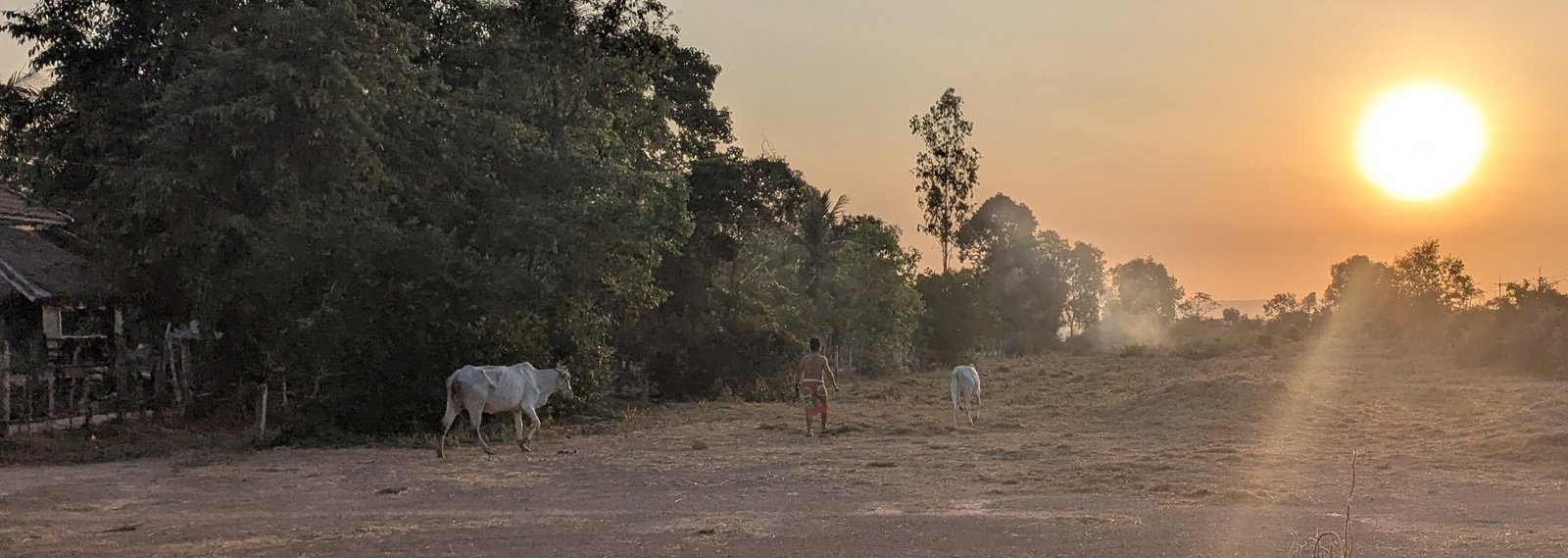
I have never seen a sun so fat. The farmer herds his cattle. Fire is loosened on the tide of light.

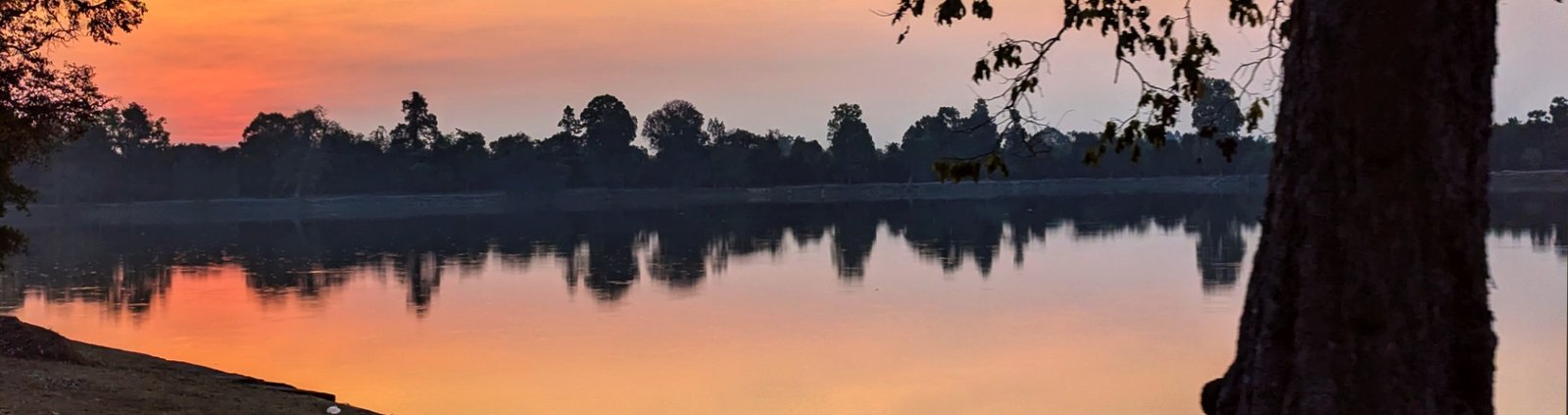
The atmosphere floats a pale constitution.
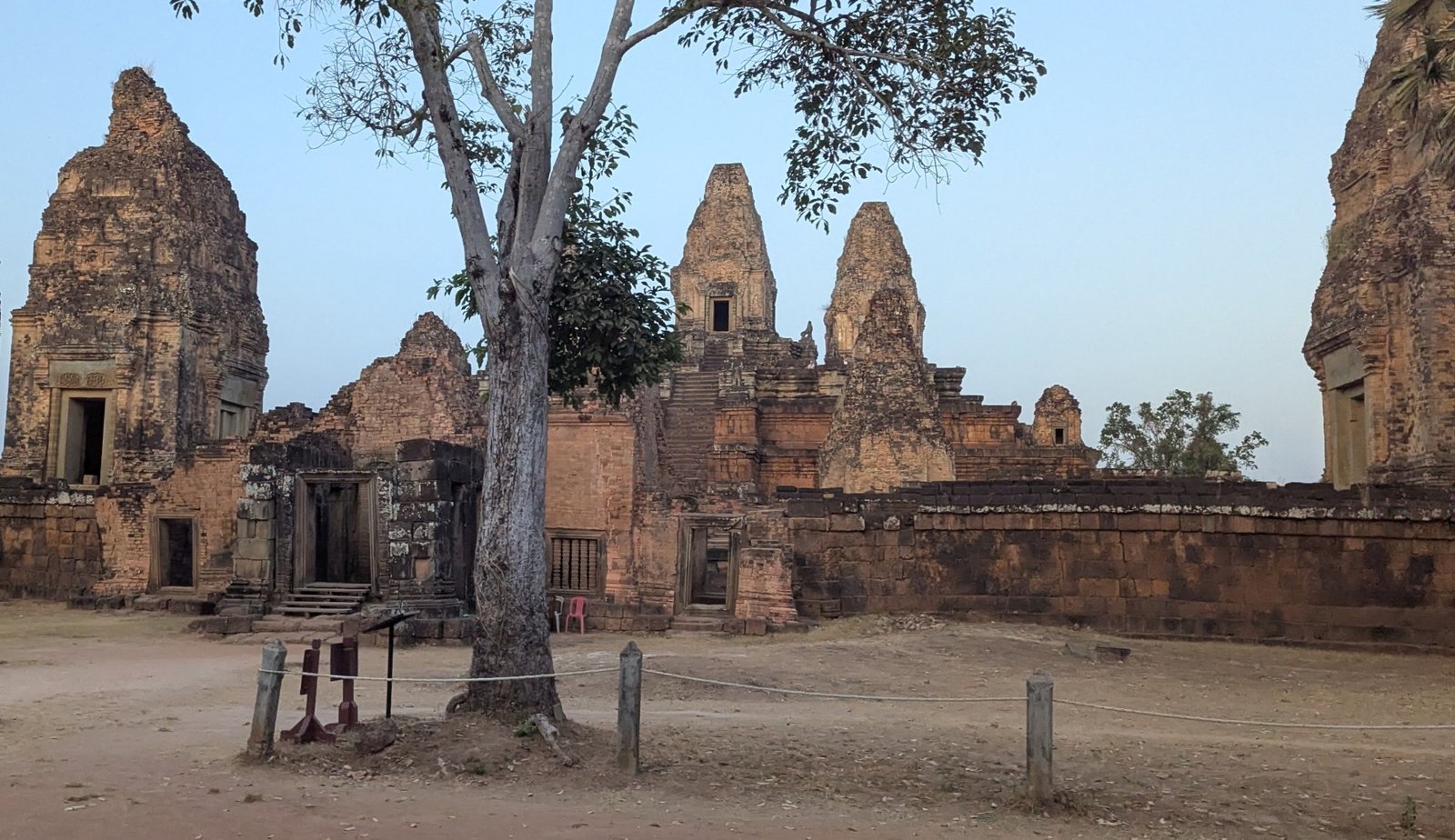
We pass another temple, the gods must be pleased. The Angkor region has over 70 major temples.
This is a dangerous nostalgia from my youthful adventures of simplicity, in agricultural landscapes, rural life smiling from weathered shelters, I would camp in. A relaxed attitude and rough attention to dirt and rubbish, not bothered by false economies. There’s time to rest in the humidity, hammocks are a way of being in a poor country, poorest after Myanmar and the Laos in South-east Asia.
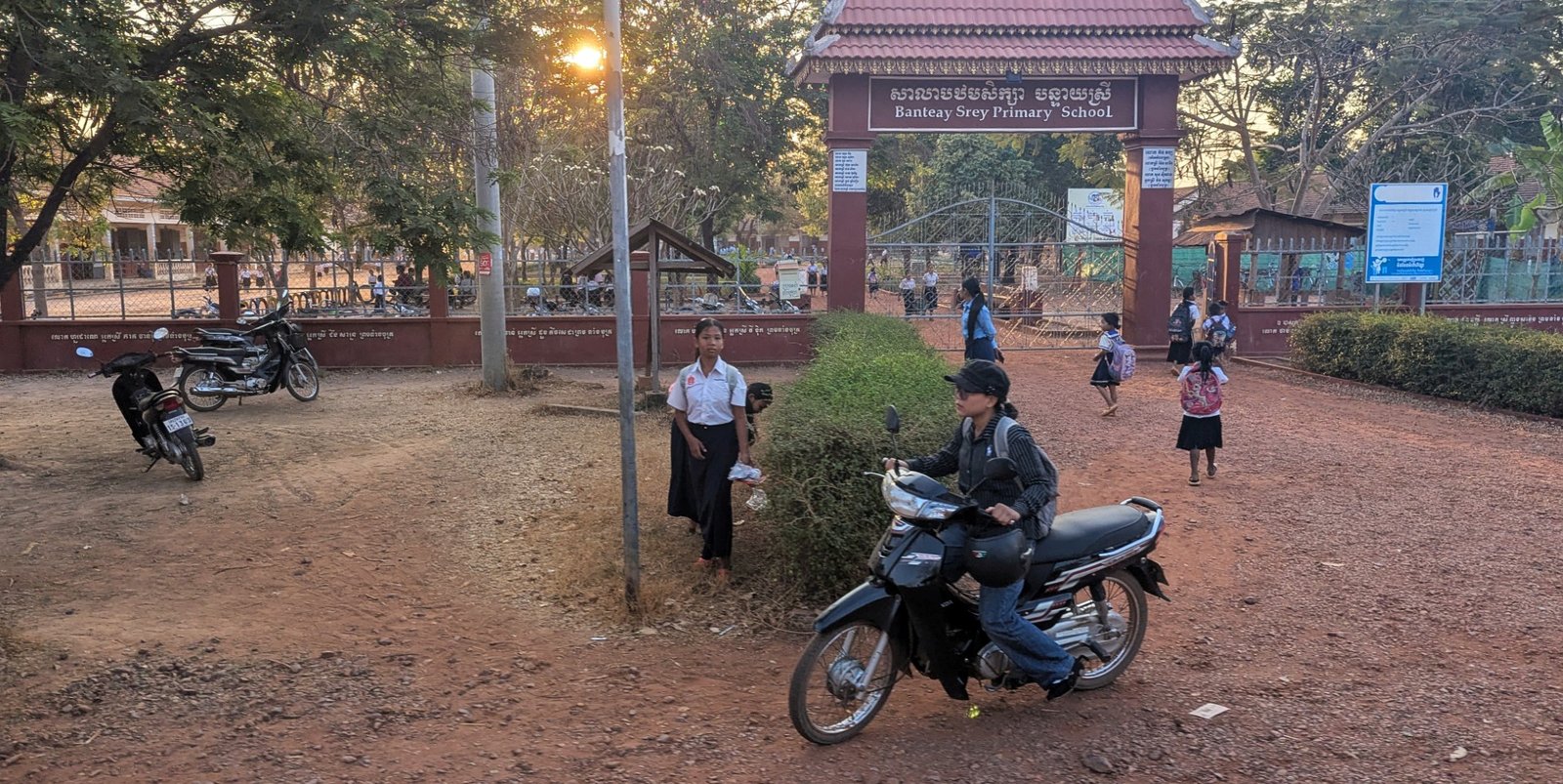
Children are going to school in clean uniforms, so many that the day is split into two. They look healthy, I want to hear excited screams from the playground. Our Tuktuk motors on.
Inside the trees
Trees surround the walls that surround the moat surrounding this exquisite temple. As a child I would have called this a castle because it has a walls and a moat. It is always summer in Cambodia, wet or dry. I will be astonished every day.
It is the dry season – February. The glory of trees and their impeccable logic choreograph the sky. You cross the moat and enter.
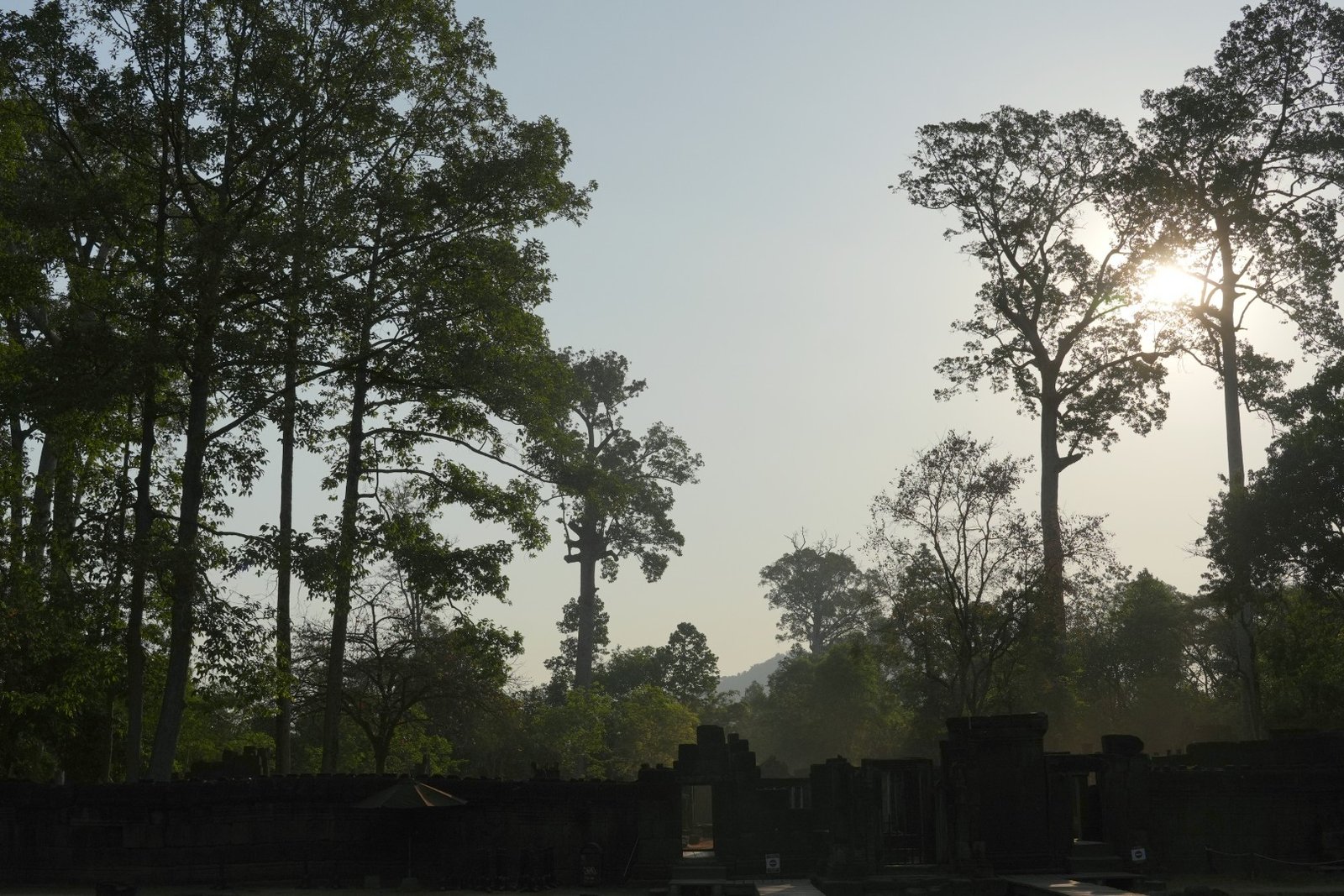
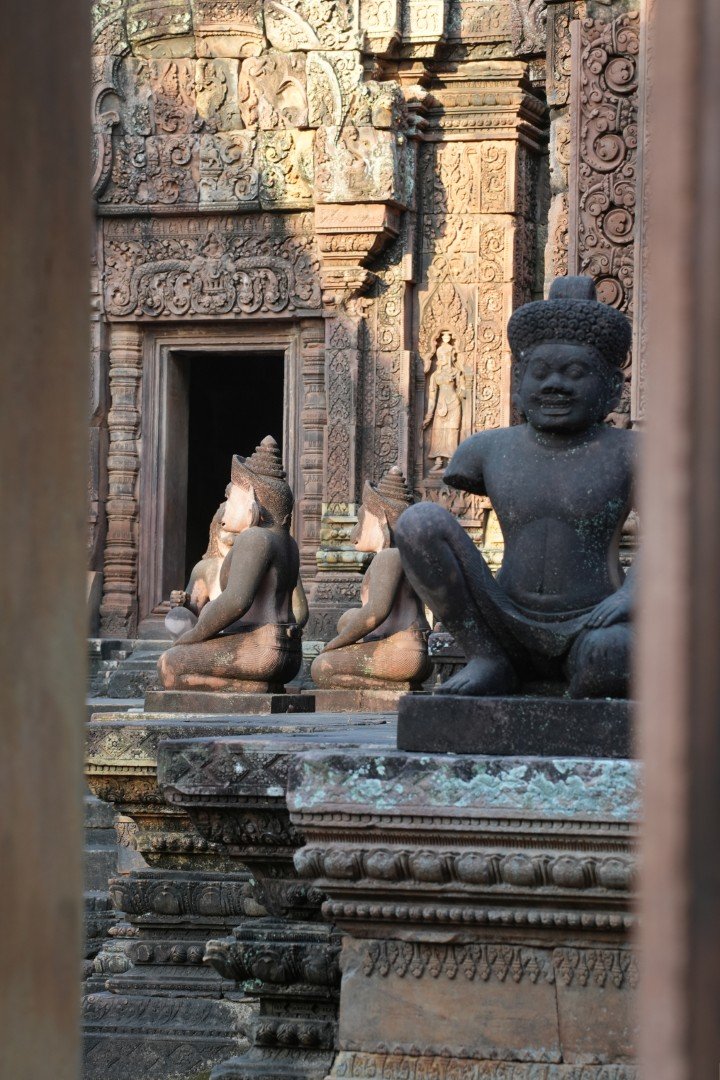
The world shrinks into this small square, external wall a hundred metres. The information board notes that this was the first temple to depict legends not just gods.
It’s quiet. We are the first ones this morning, a temporary, muscular ownership.
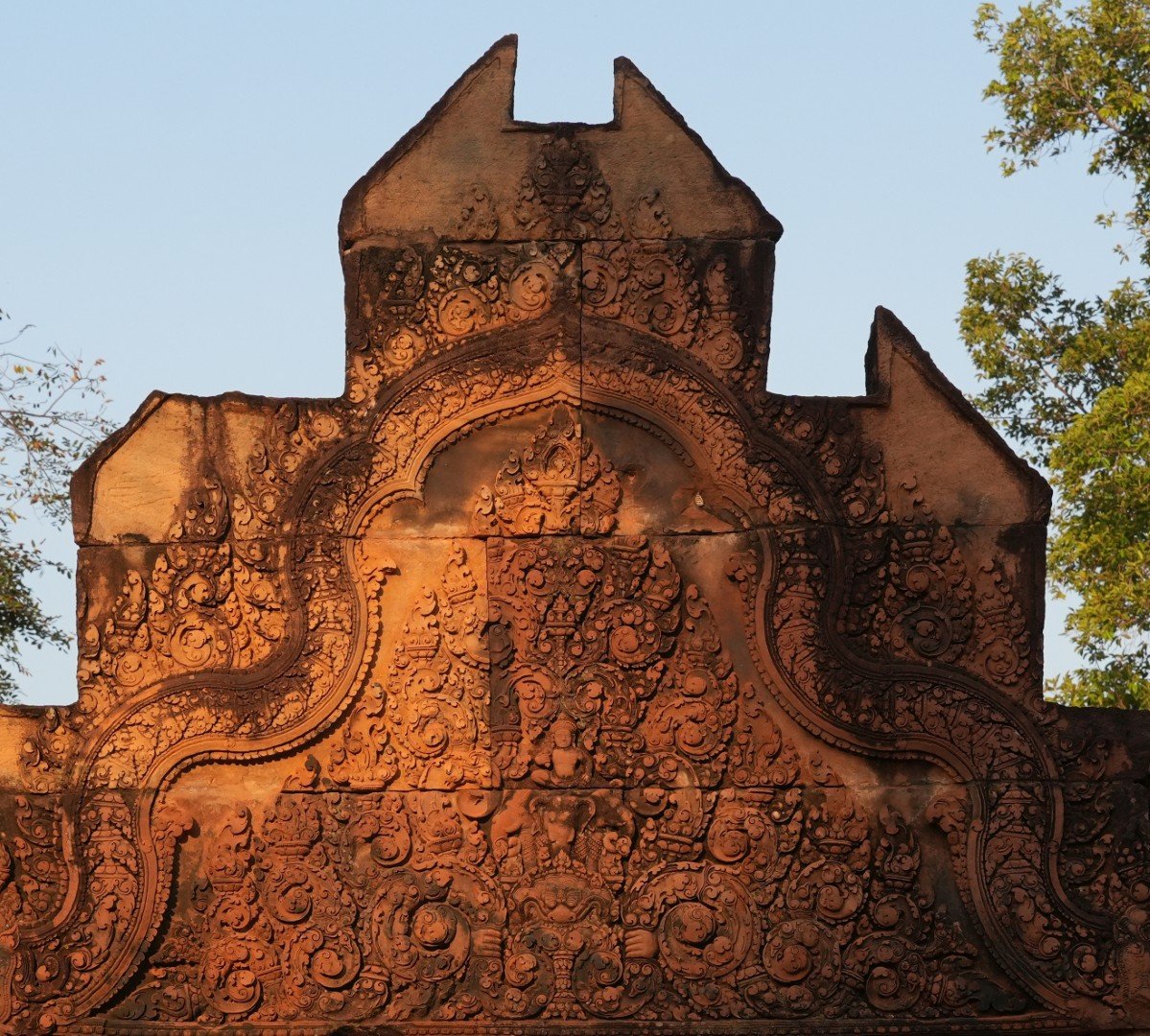
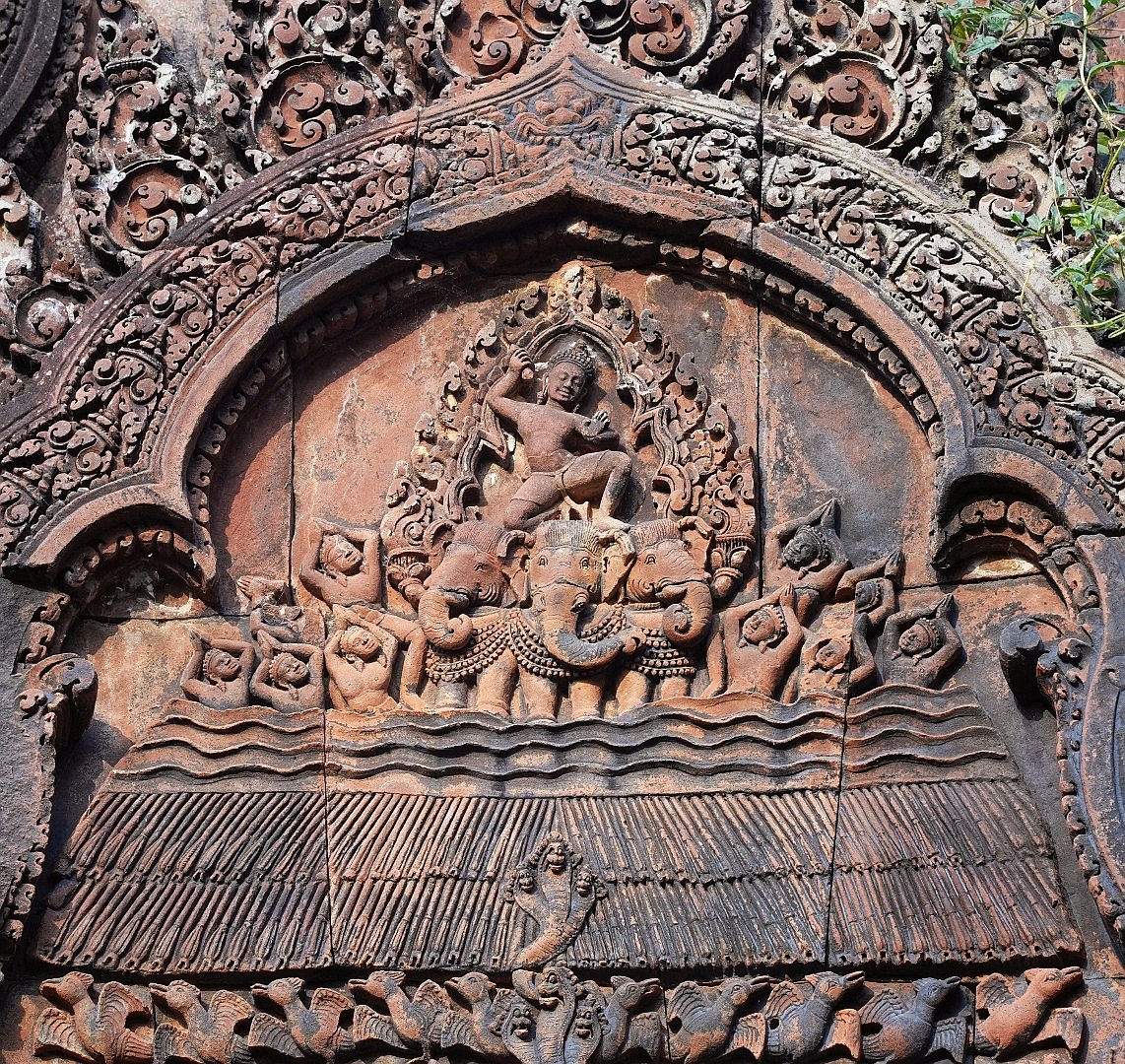
On the pediment of the Eastern Gate Indra guards the entrance. He is king of the gods, benevolent but also jealous and prone to hubris. So much older than I aspire to. The coherence is not active. He is sitting on his sacred vehicle (vahana) the three headed elephant Airavata. Born from the churning of the cosmic ocean, he represents clouds, rain, fertility and strength. Kala growls below with hands either side.
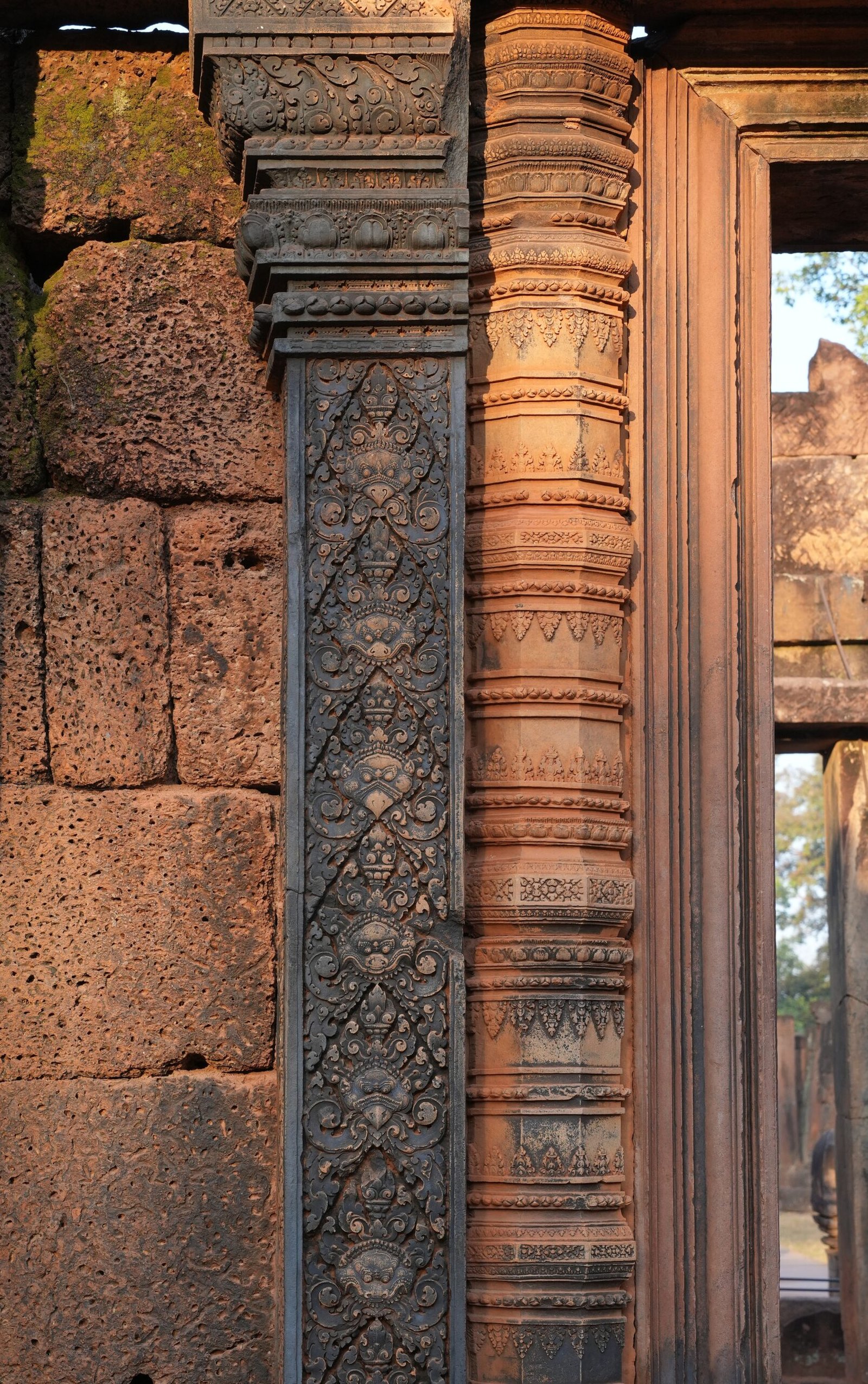
Intricately carved Kalas dedicated to Shiva guard the doorways (gopuras). With ferocious heads with many teeth, they repelled evil spirits and often had garlands in their mouths and the ends of their fingers show, but no bottom jaw. Kala is a demon commanded to devour itself and represents time. Without time, decay or death evaporate.
I am invisible to them. The density of the delicacy, somehow finding grace that is hard to funnel into a poem.
Were children as frightened of these guardians, as I was of the Mekon, a Martian-green Treen from Venus in ‘The Eagle’. A repulsive evil creature with a huge bulbous bald head and tiny atrophied body using a technologically advanced hoverchair. Constantly plotting to conquer Earth, he was an inspiration for Davros, leader of the daleks in Doctor Who. I must be older.
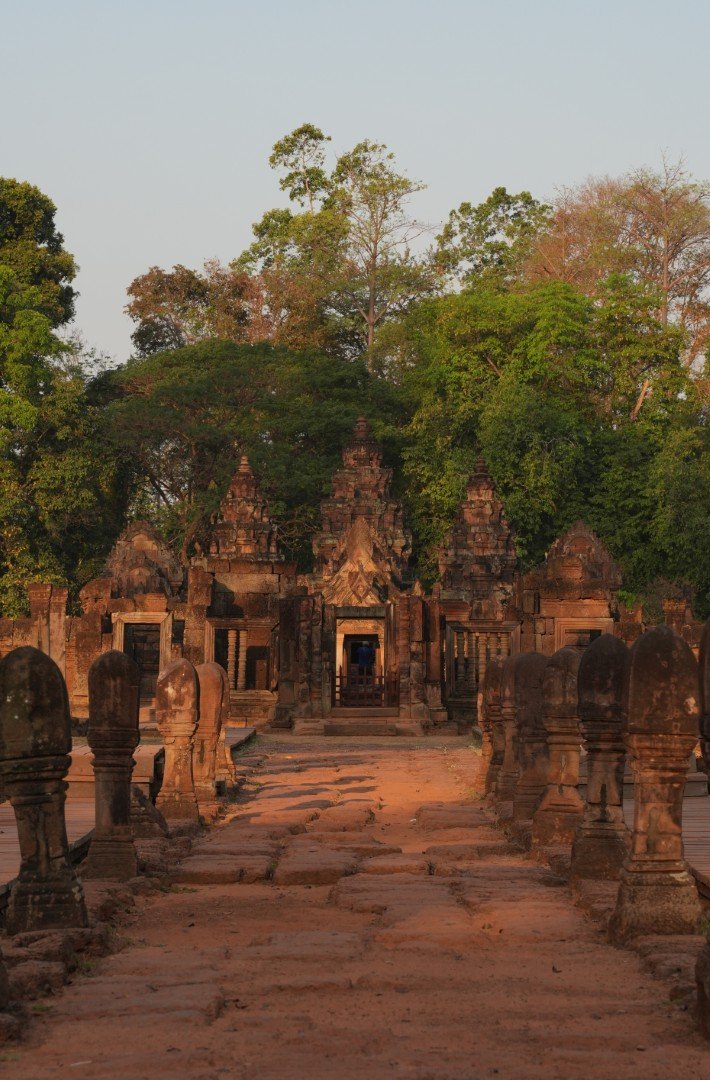
Another couple arrive, something changes. Walking towards the central tower between boundary stones casting shadows, colour erupts.
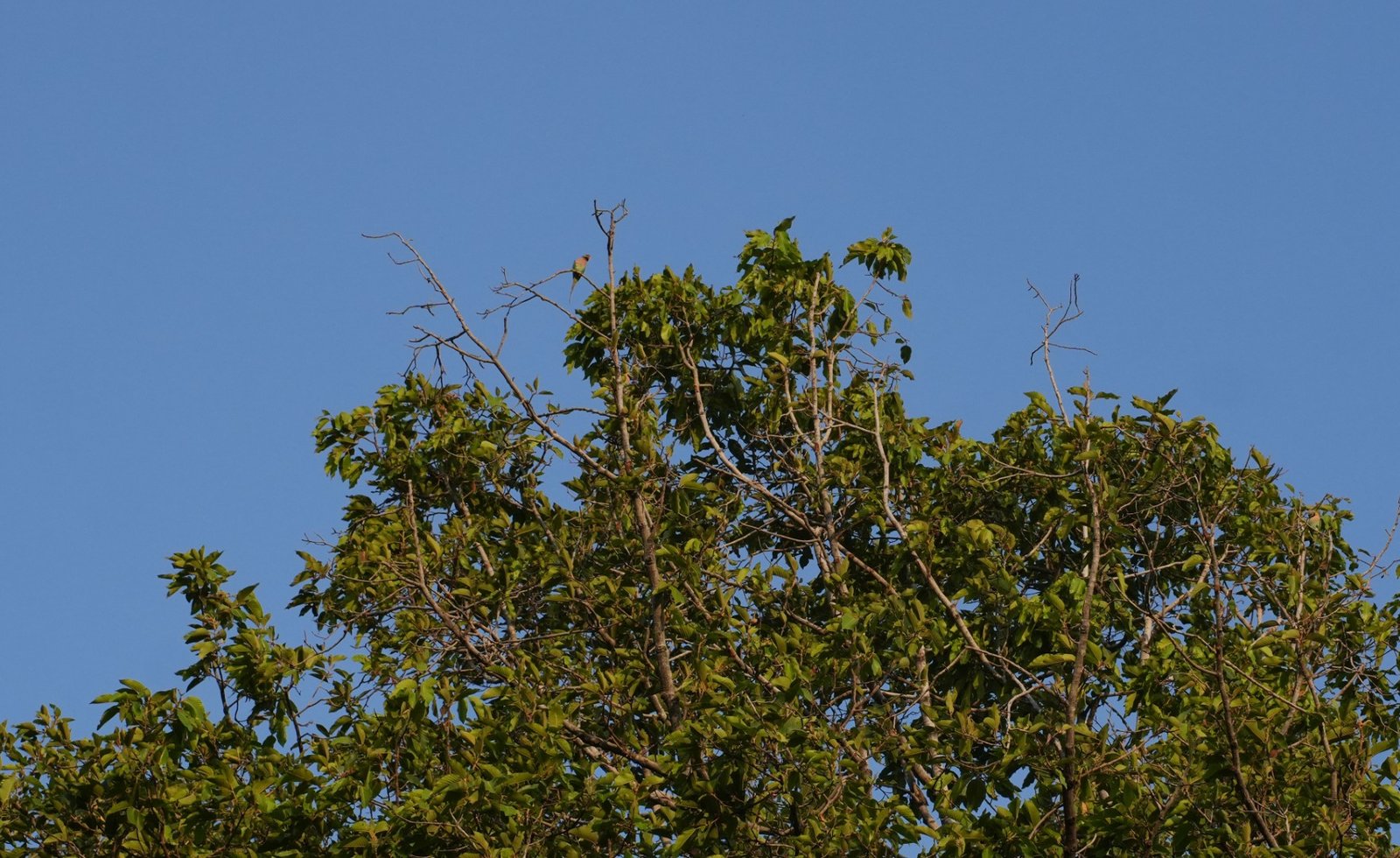
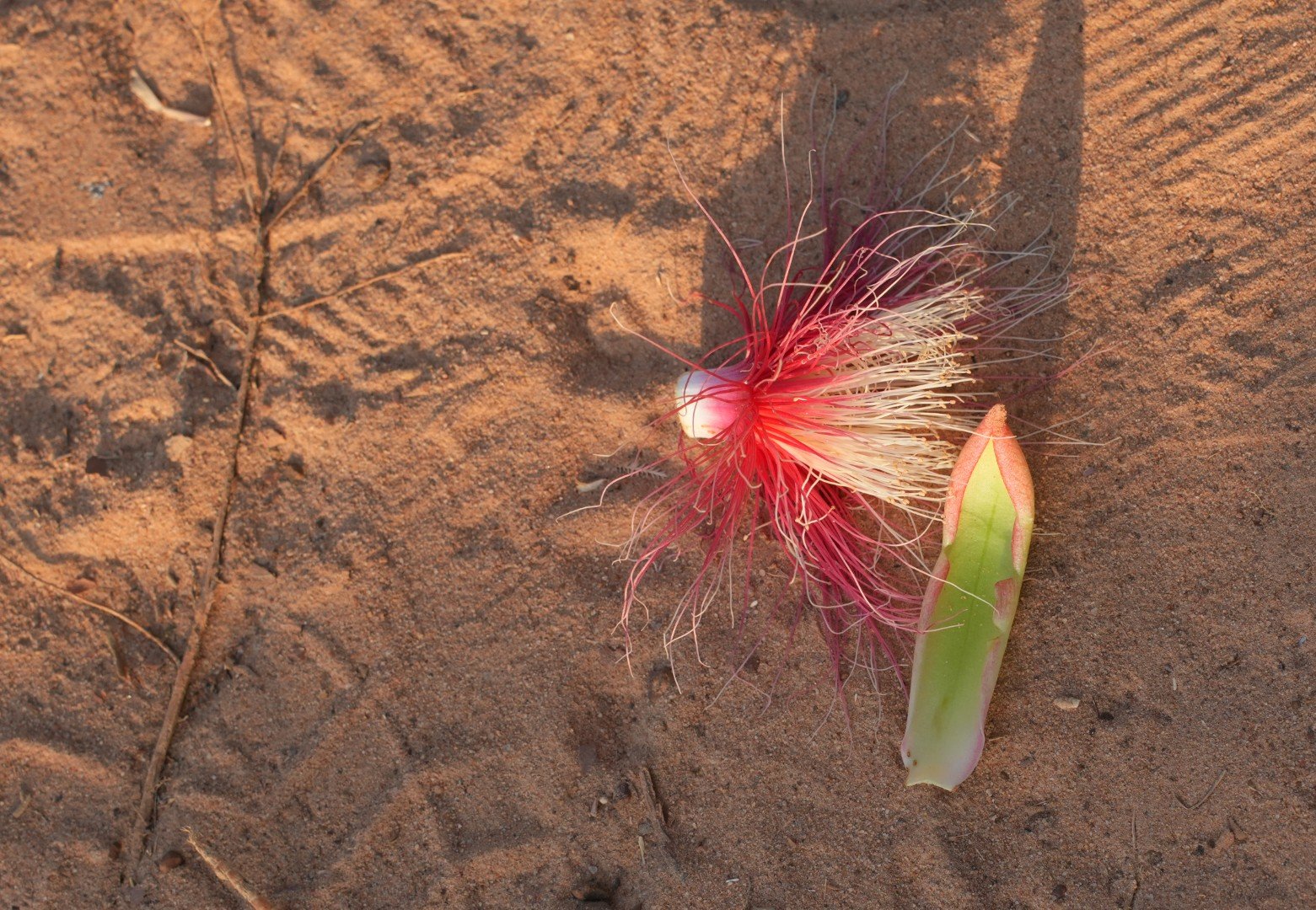
Feathers cross the air space and land on a Wild Guava, a medicine tree. Fragrant, powder-puff flowers tumble down around us. The Red-breasted Parakeets are feeding on Careya arborea, commonly known as Wild Guava (Kandol in Cambodia) is a deciduous tree used in Ayurveda and traditional medicine to treat tumours, chest problems and skin diseases Roots are used to treat aches and pains, and the leaves for healing wounds. The flowers catch the light like spiders catching flies. One just misses me.
Banteay Srei was not founded by a king, but a counsellor of Rajendravarman II and teacher of Jayavarman V, named Yajnavaraha, architect unknown. The temple was consecrated on April 22nd, 967, nearly two centuries before Angkor Wat. The temple’s original name was Tribhuvanamahesvara ‘great lord of the threefold world’ — and dedicated to both Shiva and Vishnu.
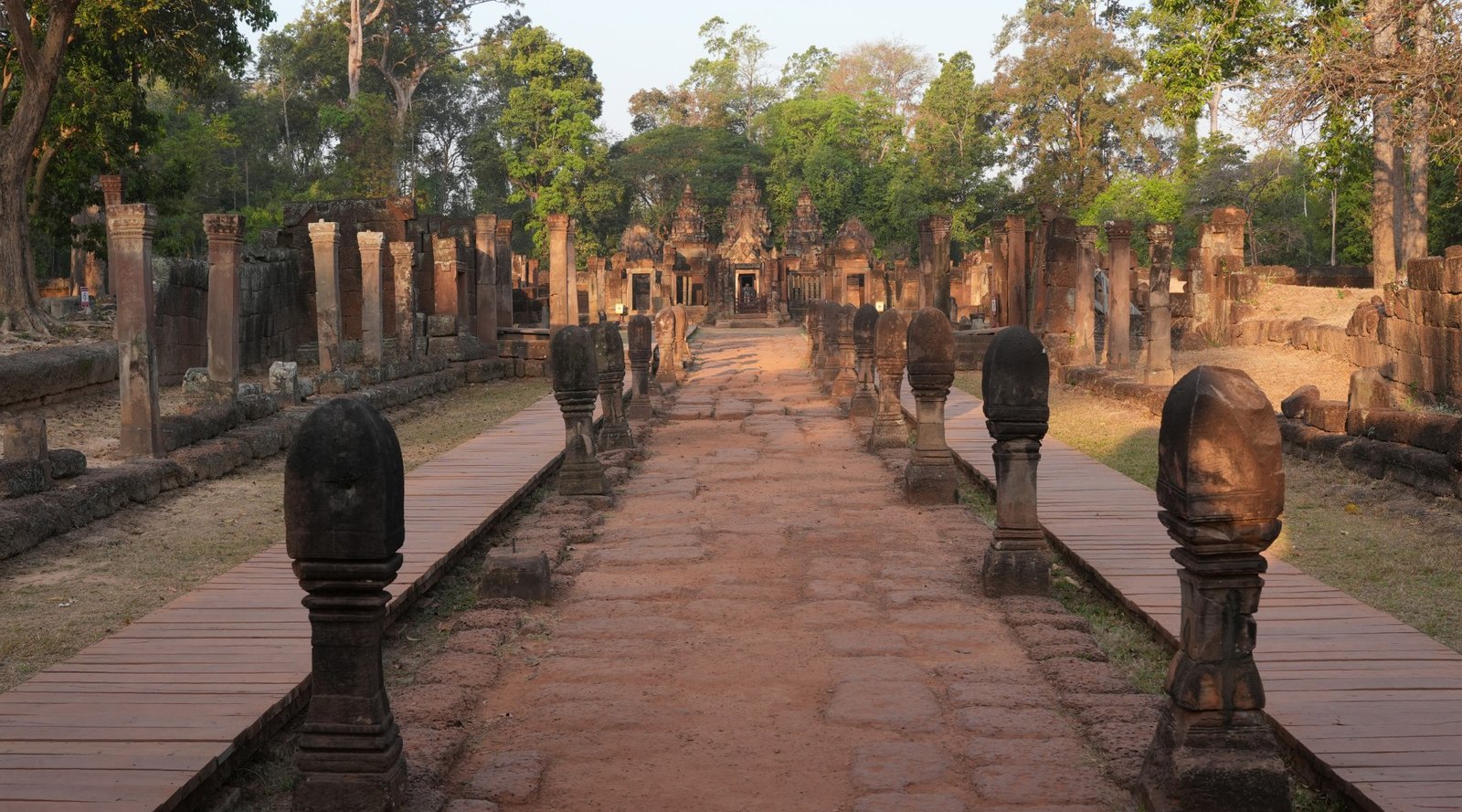
The temple was hidden from the rest of the world by forest for centuries before French archaeologists rediscovered it in 1914.
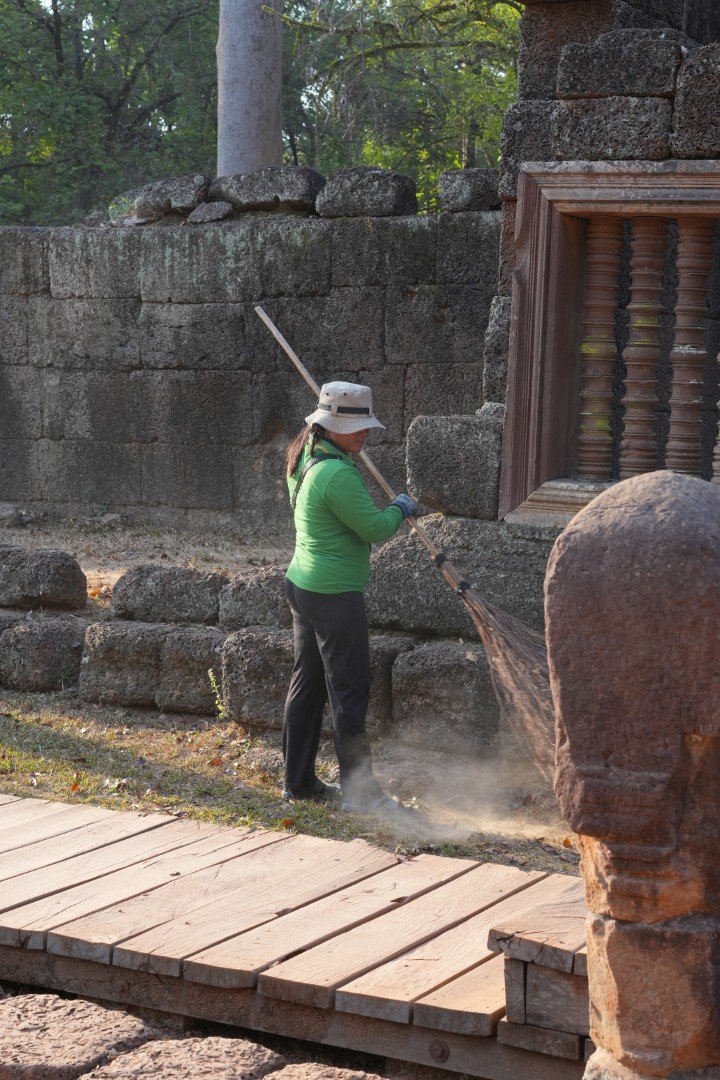
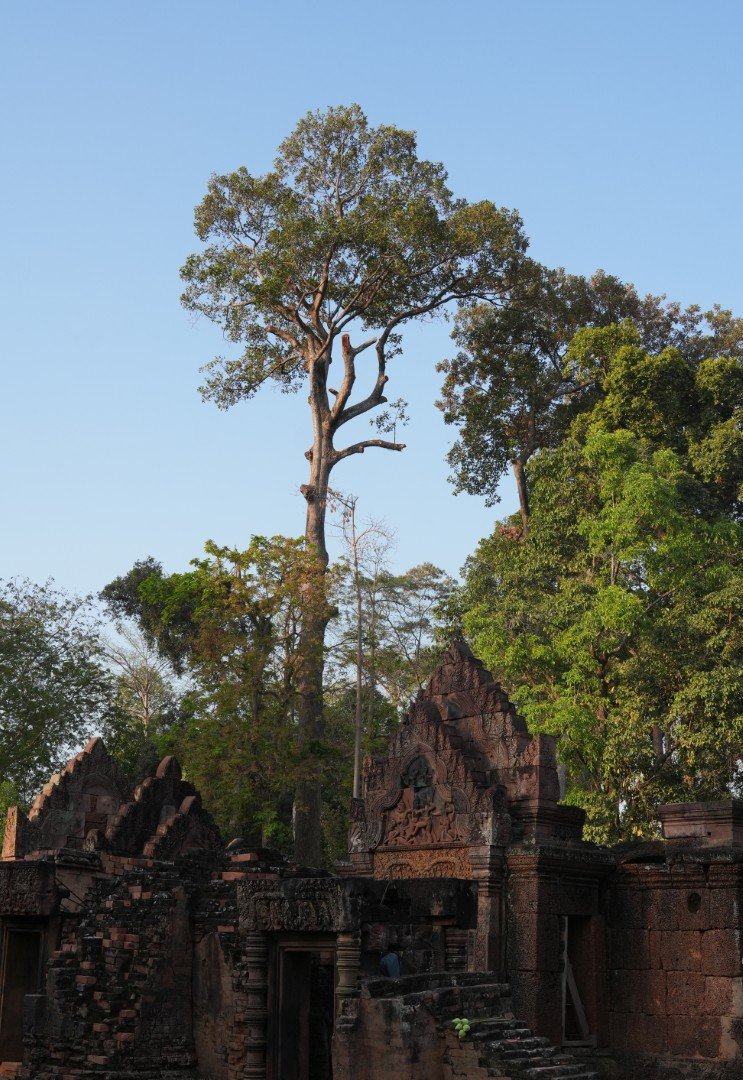
Just stone and red dust and then an apparition, a woman with a broom, sweeping traces of yesterday’s invasion away. And of course, trees that most visitors ignore.
The build
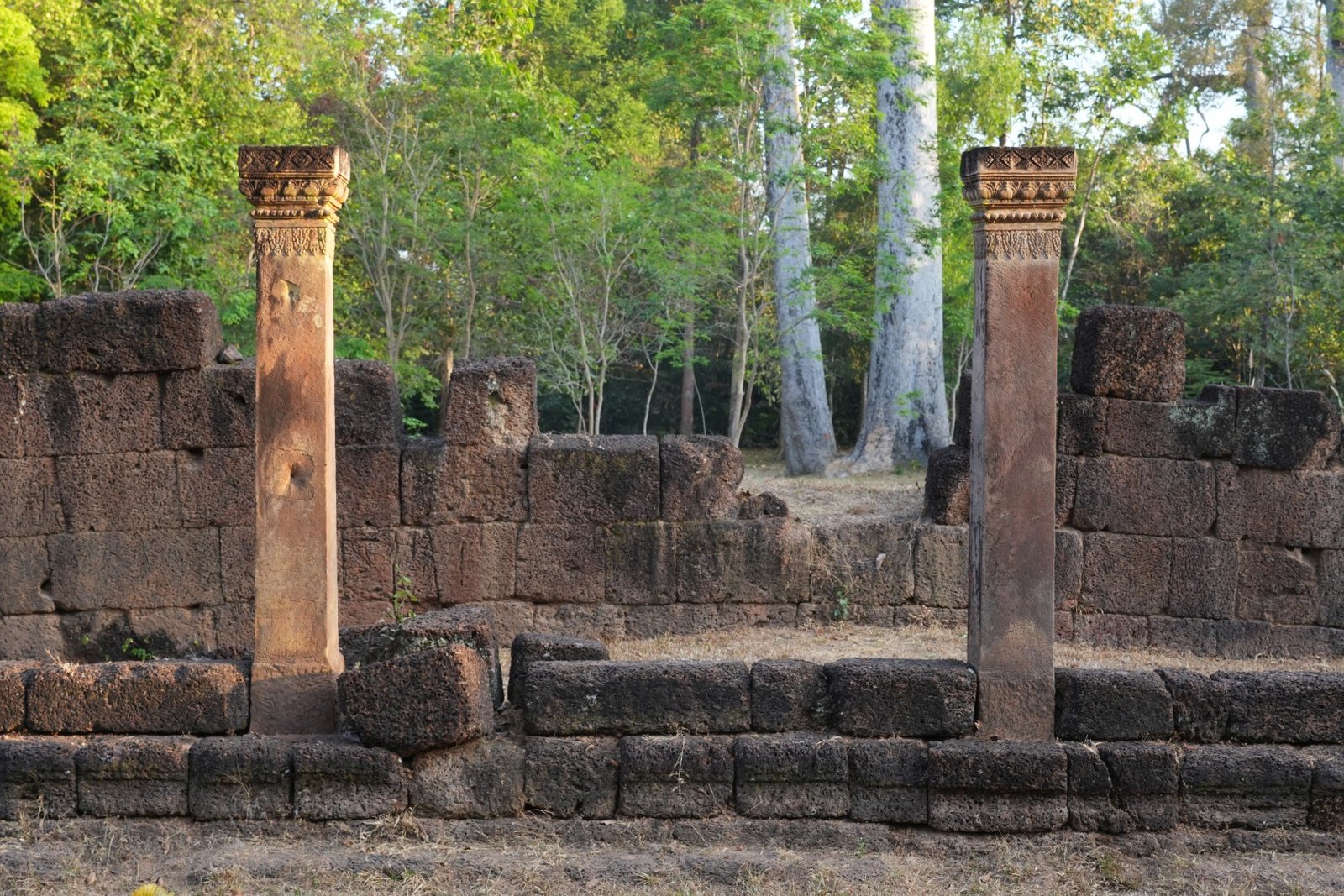
The walkway was lined by galleries. Fine carvings grace the remaining pediments and lintels.
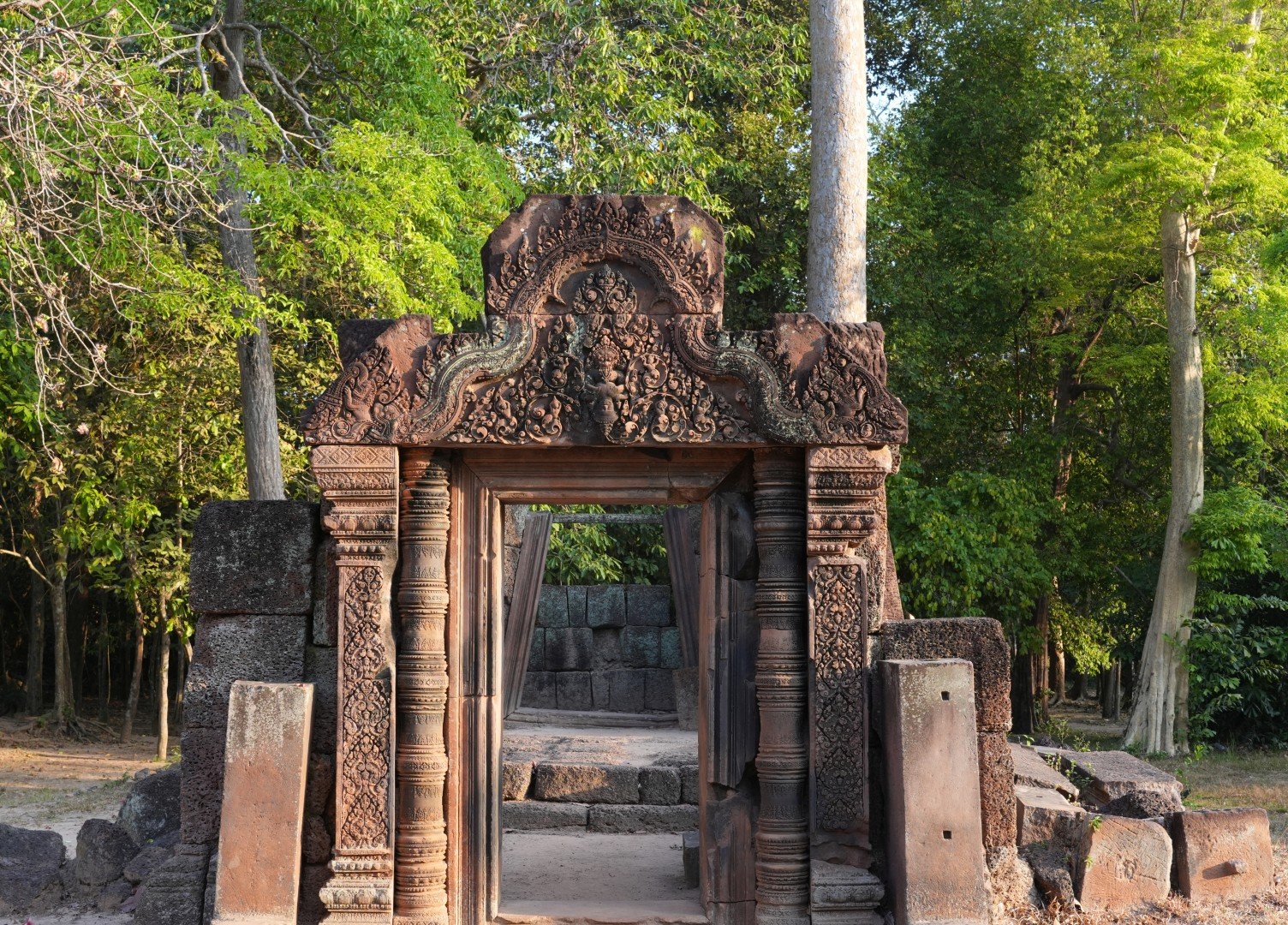
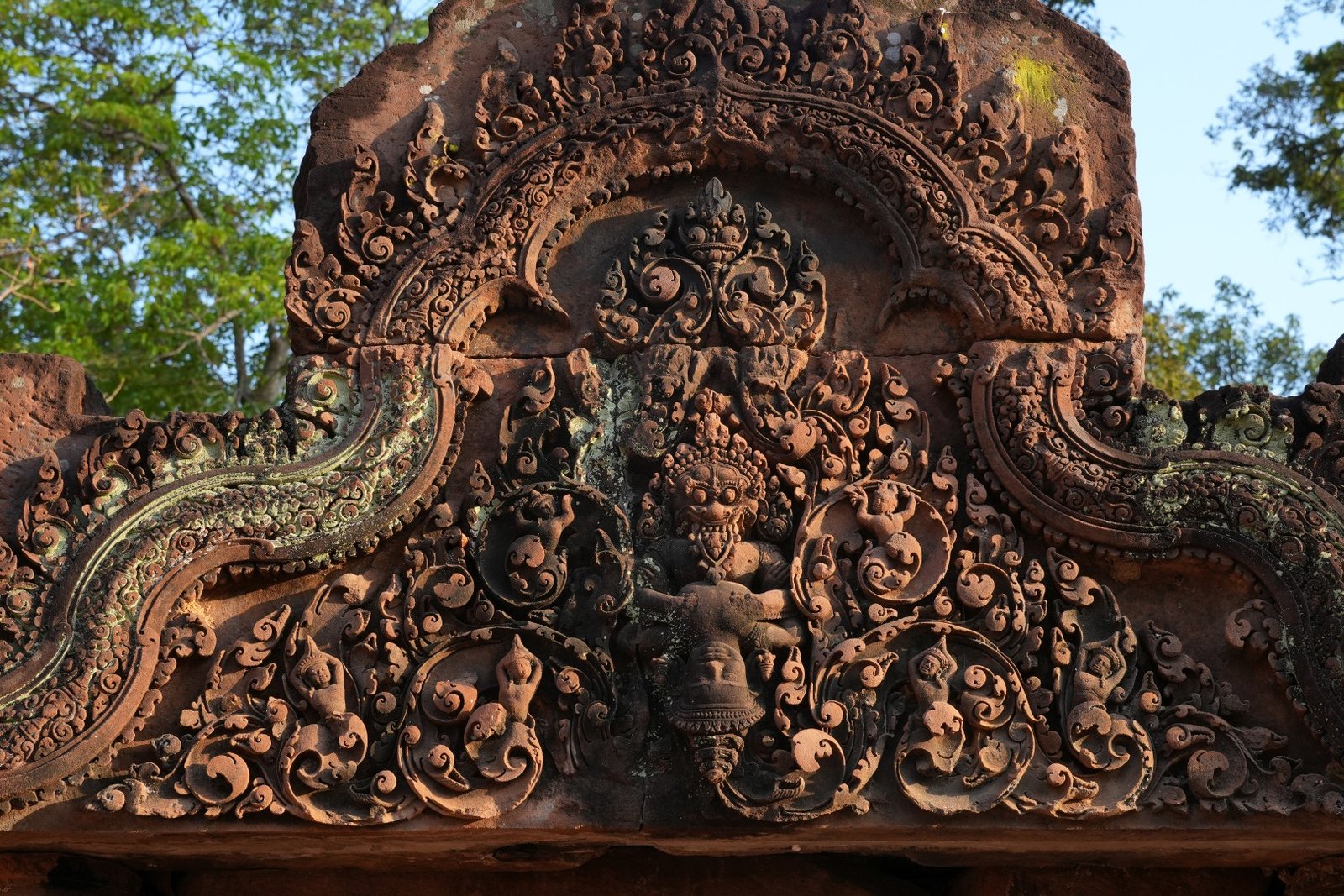 Narasimha (an incarnation of Vishnu) killing Hiranyakashipu
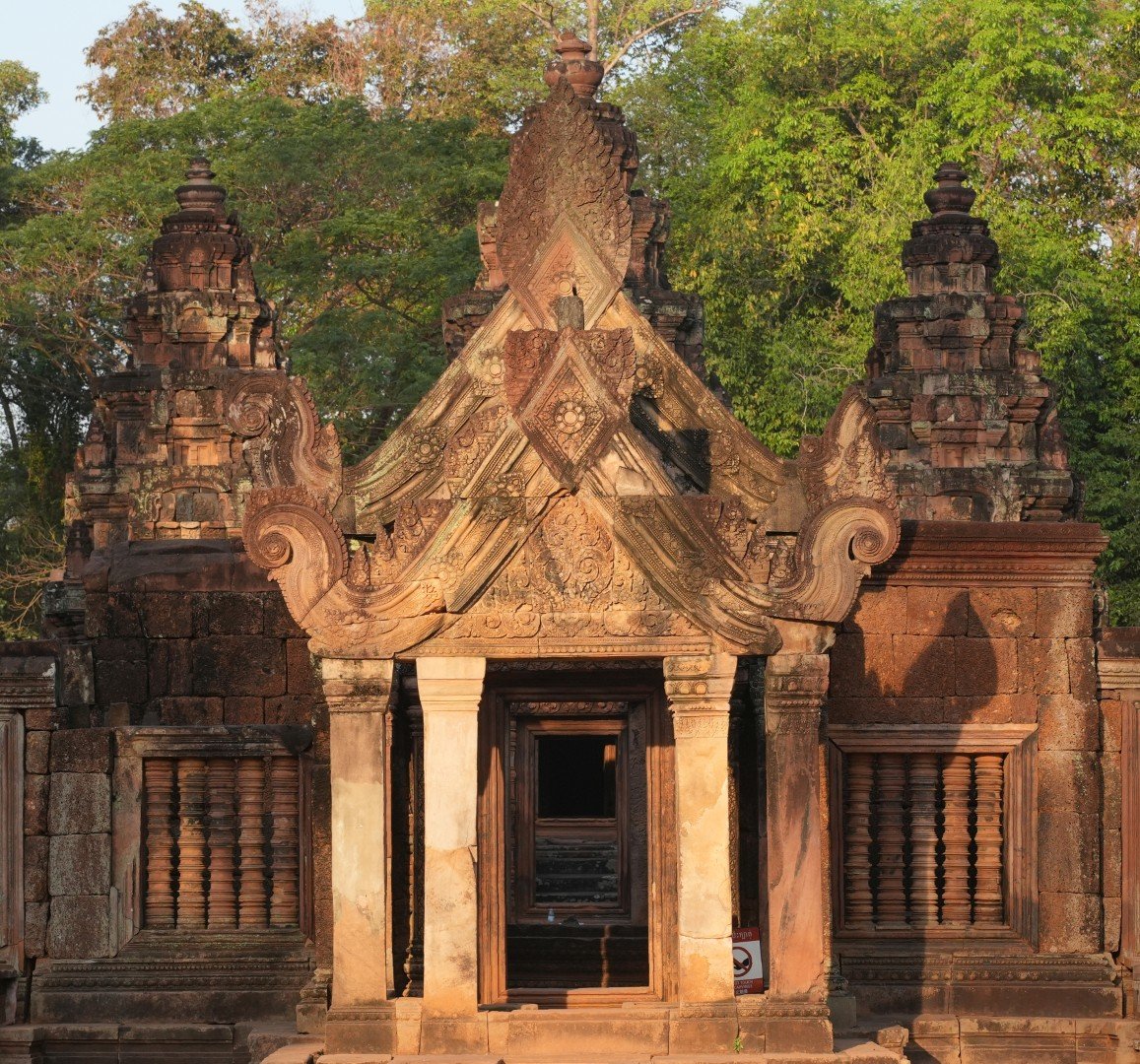
Entrance to the central shrine
The inner sanctuary supports three towers, two are dedicated to Shiva, and the northern one to Vishnu. Each is exquisitely carved with devatas. The central one is preceded by a Mandapa hall, connected with it by a corridor.
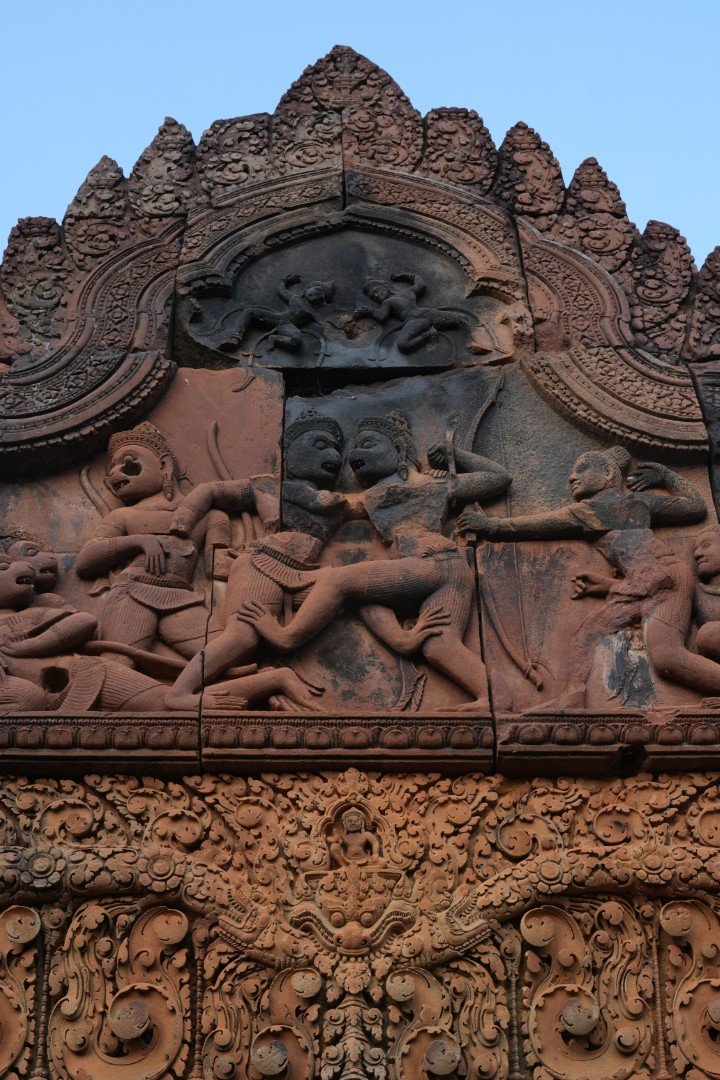
The fight between Vali and his brother Sugriva for the crown.
Krishna and Arjuna attempt to burn down the Kandhava forest of evil creatures. Arjuna, the archer, shoots a flurry of arrows to prevent the rain from hitting the ground. A transmutation of fire into stone. Forces collide, an arrow dowses a forest fire with a little help from a finely carved figure. They inhabit space, I’m just not sure which one.
If you had to choose between knowing the names of the trees or the names of the gods and demons, or between knowing the local ecology or the Khmer myths and their contexts . . .
The carvings are a sanctuary for stories, the camera automatically feeds on them.
Why are there no frogs? The Moat must have had frogs and after all, their metamorphosis is the most miraculous of all, along with the butterfly.
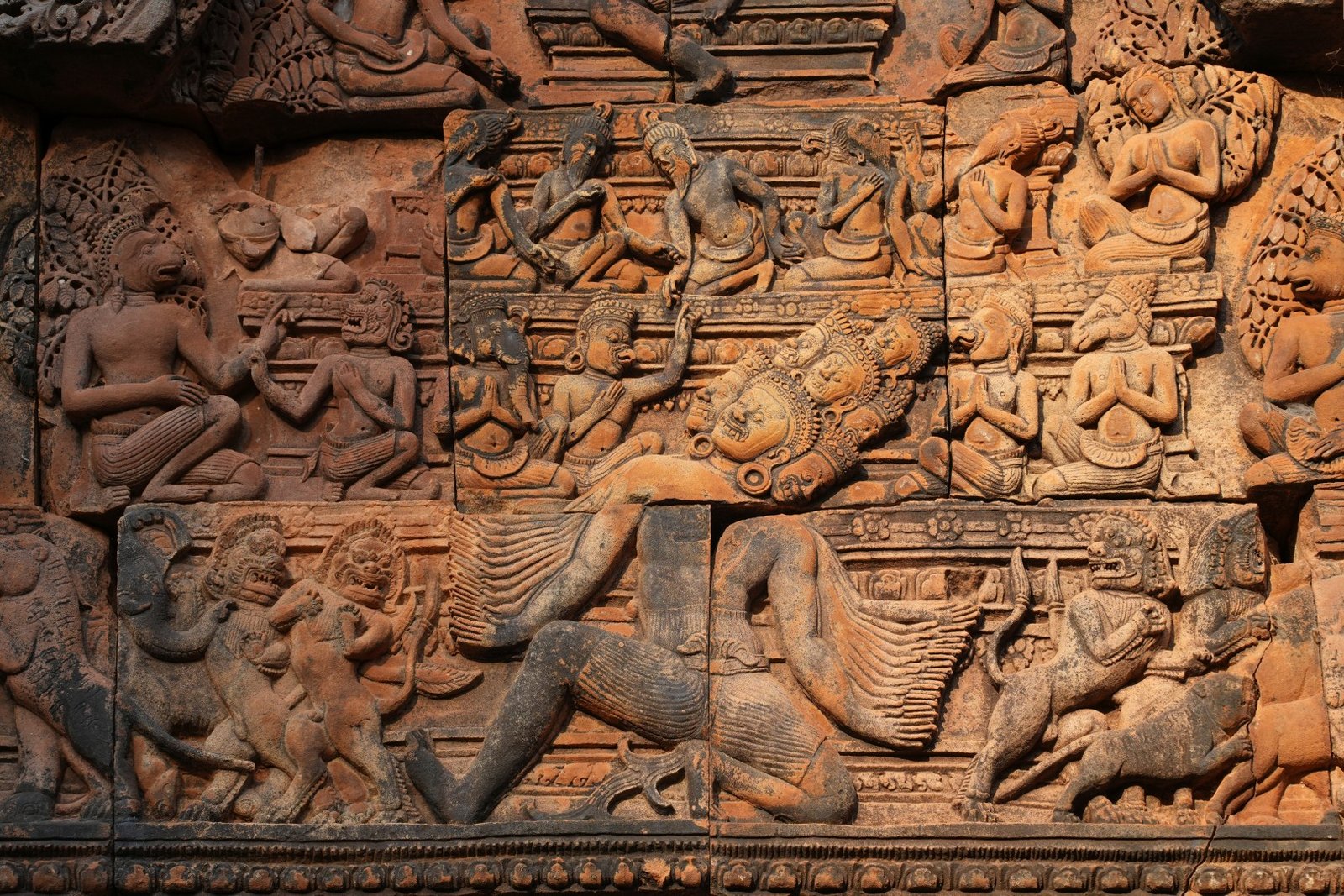 Shiva, Uma, and ten-headed Ravana, story from the Ramayana, South library
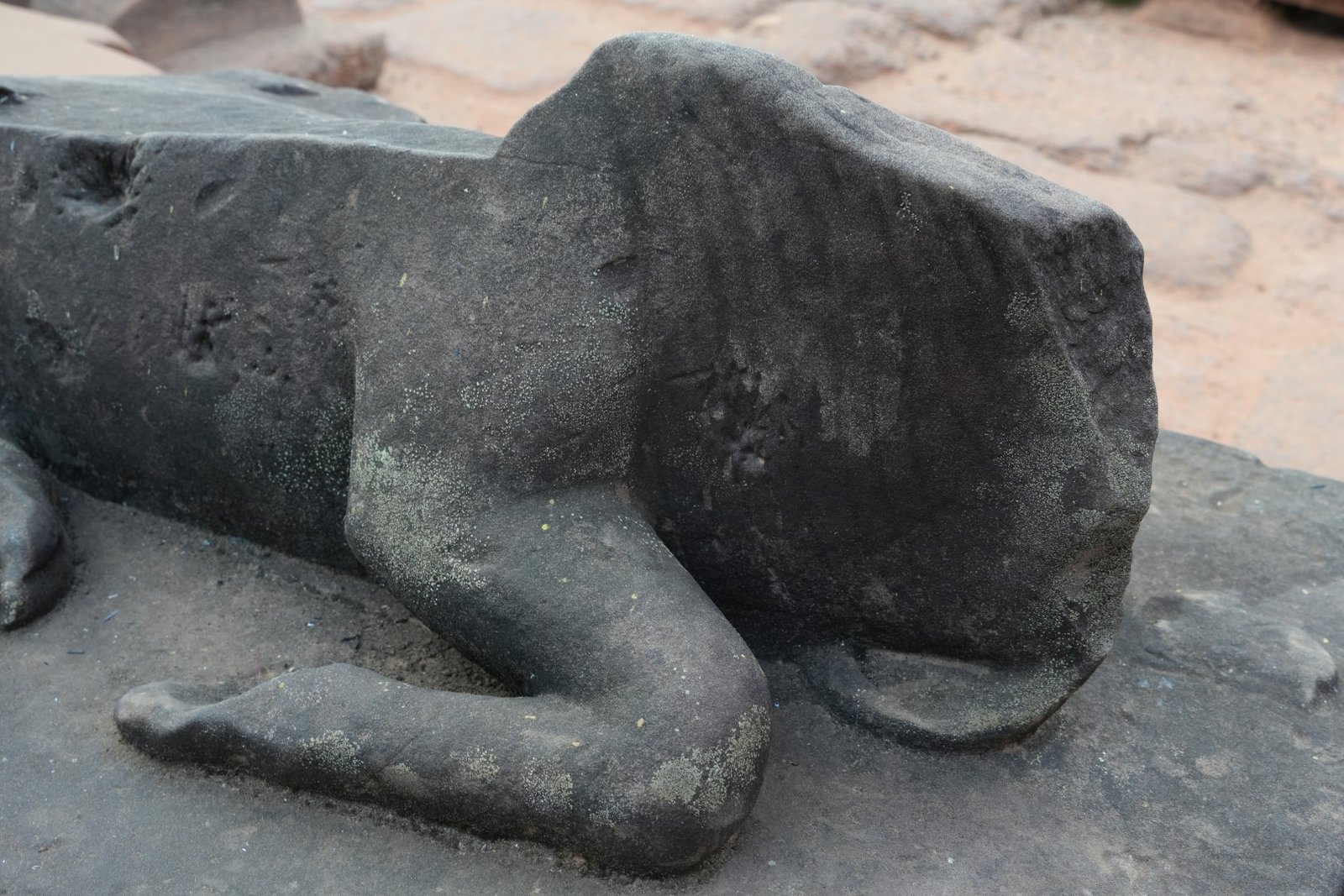 What’s left of Shiva’s mount, the bull Nandi. Nandi represents devotion and strength. Then for me, there is the mystery of the substance itself, the nature and qualities of rock.
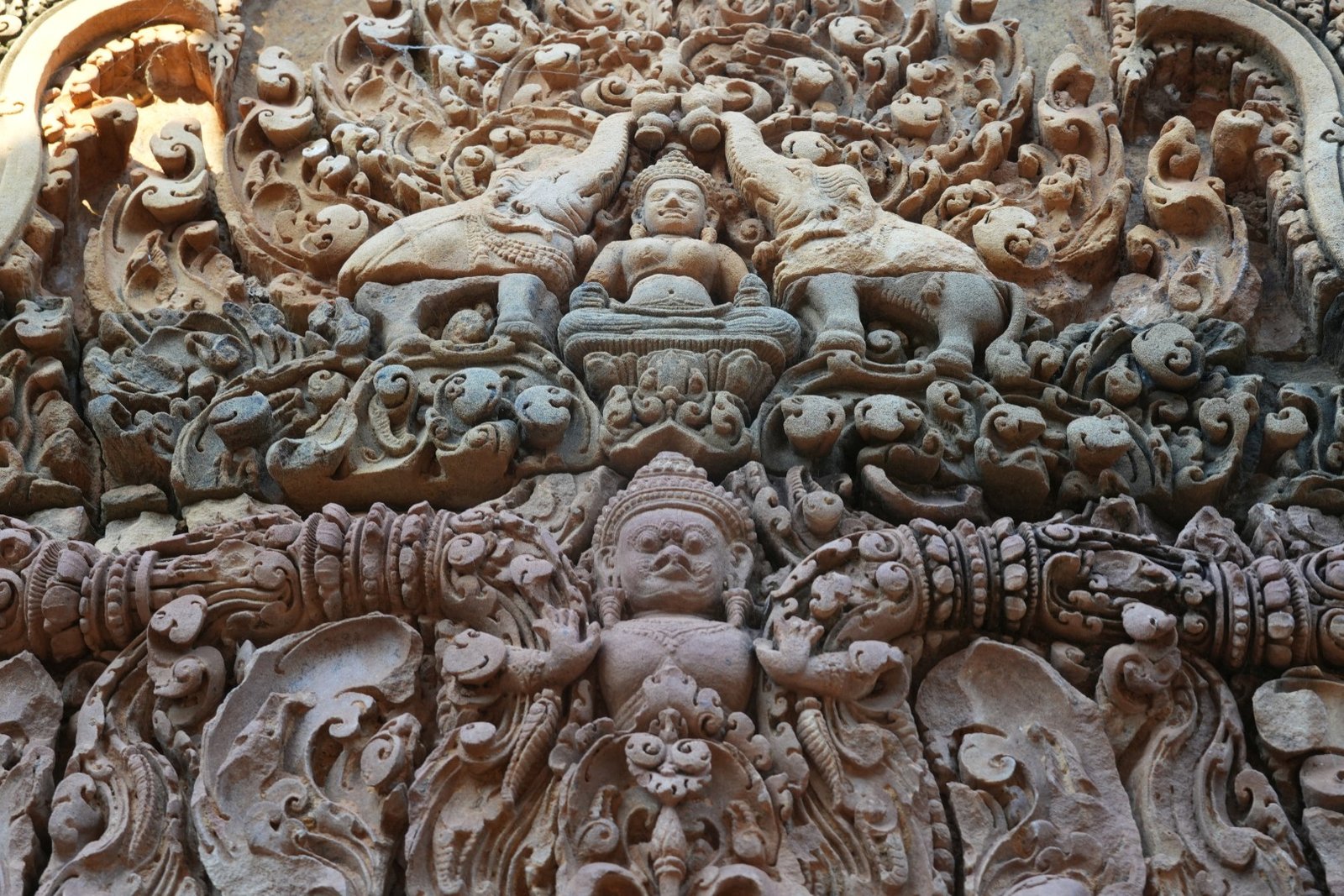 Lakshmi seated on a lotus flower riding the Uluka the owl, the vahana of Lakshmi, the Hindu goddess of wealth.
Two elephants (gajas) wash her, a ritual known as Gajalakshmi.
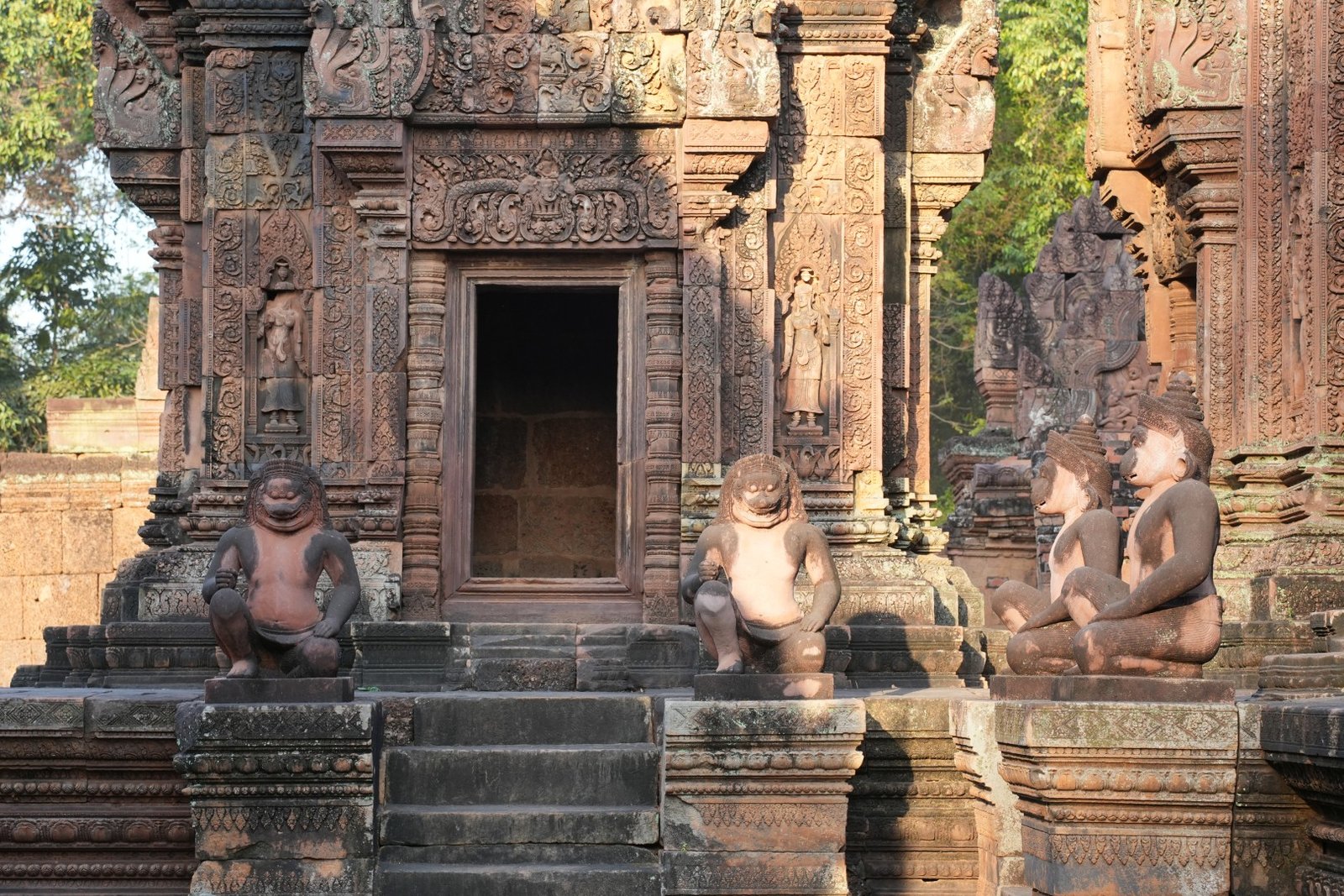
The Monkey warriors (Vanara) from the Ramayana are copies, so many have been stolen. We are lucky to have the Apsaras.
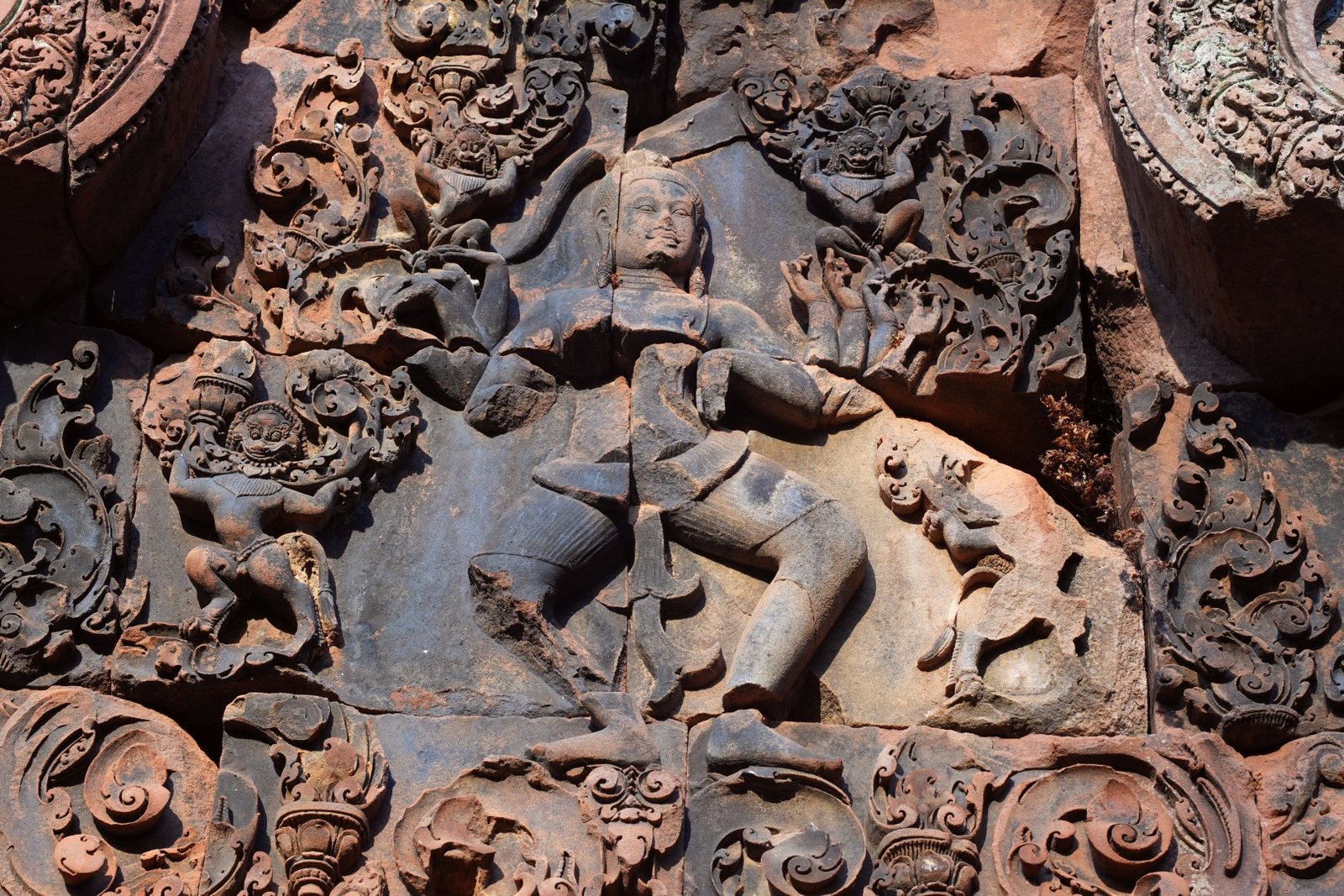 Shivas dances, teaching us that birth and death, creation and destruction are all aspects of life.
I don’t know most of their names or what powers they have, their purpose or what side they are on – good or evil, or is there a third option? So much here but so much missing. No sense of atrophy, even as the hours pass and I feel myself getting older. Armies, fornication, tentacles, sleep, words, What else is missing from here?
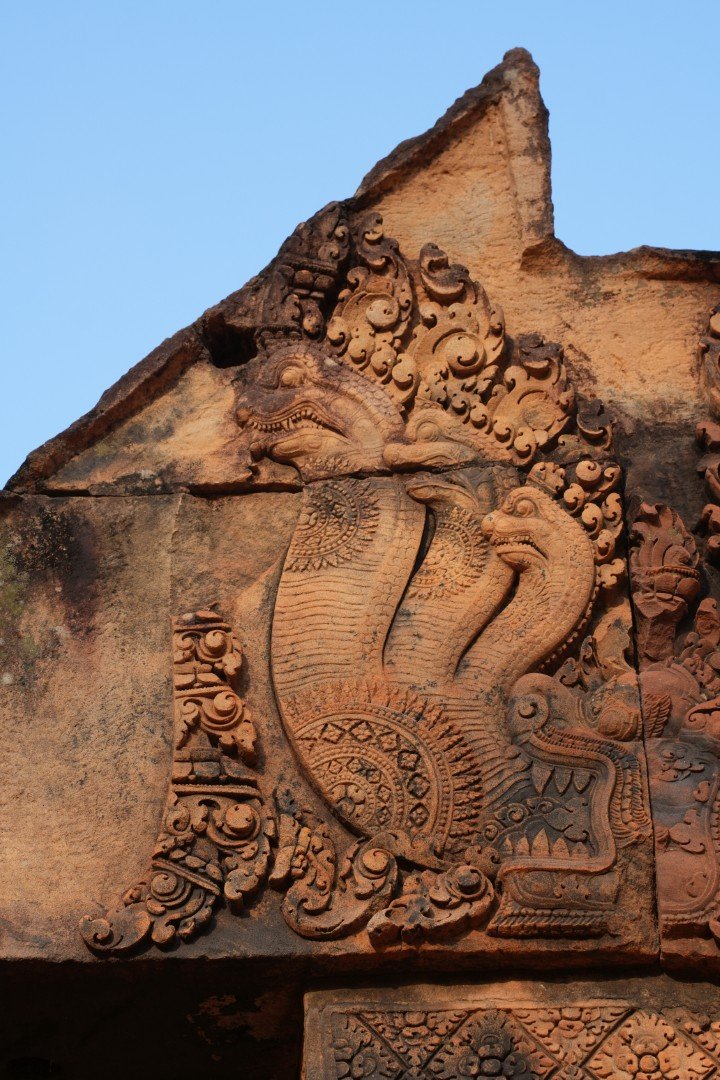 Three-headed naga (serpent), another guardian.
‘Stories are cognitive technologies: they must arouse curiosity and suspense, tap into our fears and hopes, and offer something that repays the time we spend with them.’ Manvir Singh
There is no single definition of myth. Elizabeth Baeten writes: ‘Myth is an essential strand of cultural production; it is the means by which a human being determines, discovers, and delimits its own range, its own boundaries.’ She analysed theories of myth by Ernst Cassirer, Roland Barthes, Mircea Eliade, and James Hillman. She argues that for them myth is, ‘the creative act through which humans articulate and constitute the distinction between human being and the world for human being.’ As opposed to these four, she argues for the radical continuity of the human and non-human spheres and not ontological discontinuity.
The issue of myth vs oral history is tricky. Barthes complained that, ‘Myth deprives the object of which it speaks of all History. In it history evaporates.’ So immediate is this past, it is neither forgotten or a burden. This text vibrates in time between the past, always as mythological as historical, the present, stretching, and the future fixed in Lucida Sans Unicode. Words loaded into paper, onto a screen, or very rarely dancing on an eardrum.
Lucas Varro is an artist and writer who has explored Angkor temples for over ten years. He writes: ‘Banteay Srei is often called the highest achievement of Angkorian art, and the phrase is usually justified by craftsmanship alone. But its deeper achievement lies elsewhere. This is a temple that teaches attention. It does not overwhelm the visitor into silence; it invites silence by rewarding patience. Stand too far back and the reliefs collapse into pattern. Step closer, and entire worlds emerge . . .
Banteay Srei does not teach grandeur. It teaches care. It reminds us that sacredness can be concentrated without being diminished, that beauty need not announce itself loudly to endure. In a landscape defined by empire and ambition, this small citadel endures as a quieter lesson: that attention, once given fully, becomes its own form of reverence.’
Why are so many people satisfied with just one god?
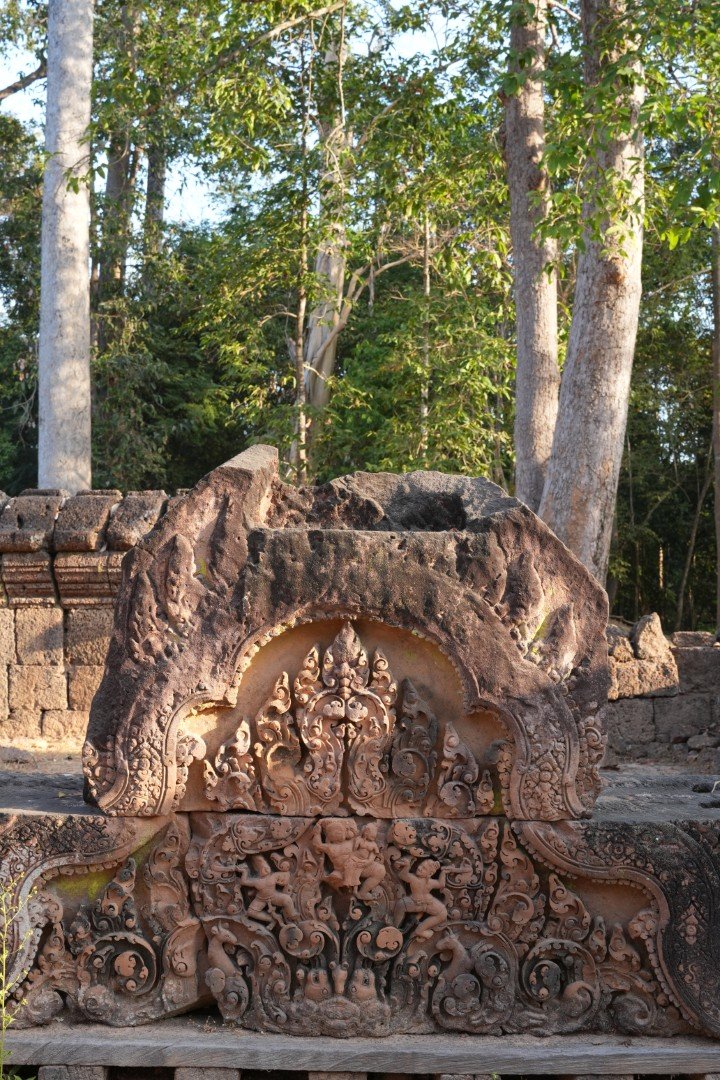 Ravana abducting Sita, from the Ramayana. The pediment is grounded.
The Ramayana is an Indian epic poem focused on the journey of Rama (an avatar of Vishnu), dated between the 7th and 4th centuries BCE. Though Rama was next in line to rule the throne, the mother of one of his half-brothers convinced the king to let her son rule. Rama went into exile with his wife Sita and his brother Lakshmana. While in exile, they saved villages from rakshasa monsters, which angered their king, Ravana who ruled the island of Lanka (Sri Lanka).
He abducted Sita and the poem tells of Rama trying to find Sita. When he does, a great war ensues at Lanka. Rama makes friends with the monkey king Sugriva by helping him take back the throne from his brother, Valin. Sugriva’s subordinate Hanuman then becomes one of Rama’s closest friends and allies, and plays a major role in the war. 33 primary gods take part, plus deities, sages, and celestial beings. [The war is depicted in detail at Angkor Wat].
There are also scenes from the Mahabharata (400 BCE to 300CE) featuring a huge number of gods, demigods, and divine beings involved in a brutal war between two brother cousins Kauravas and Pandavas for control the throne. I missed Krishna slaying his uncle on the North Library.
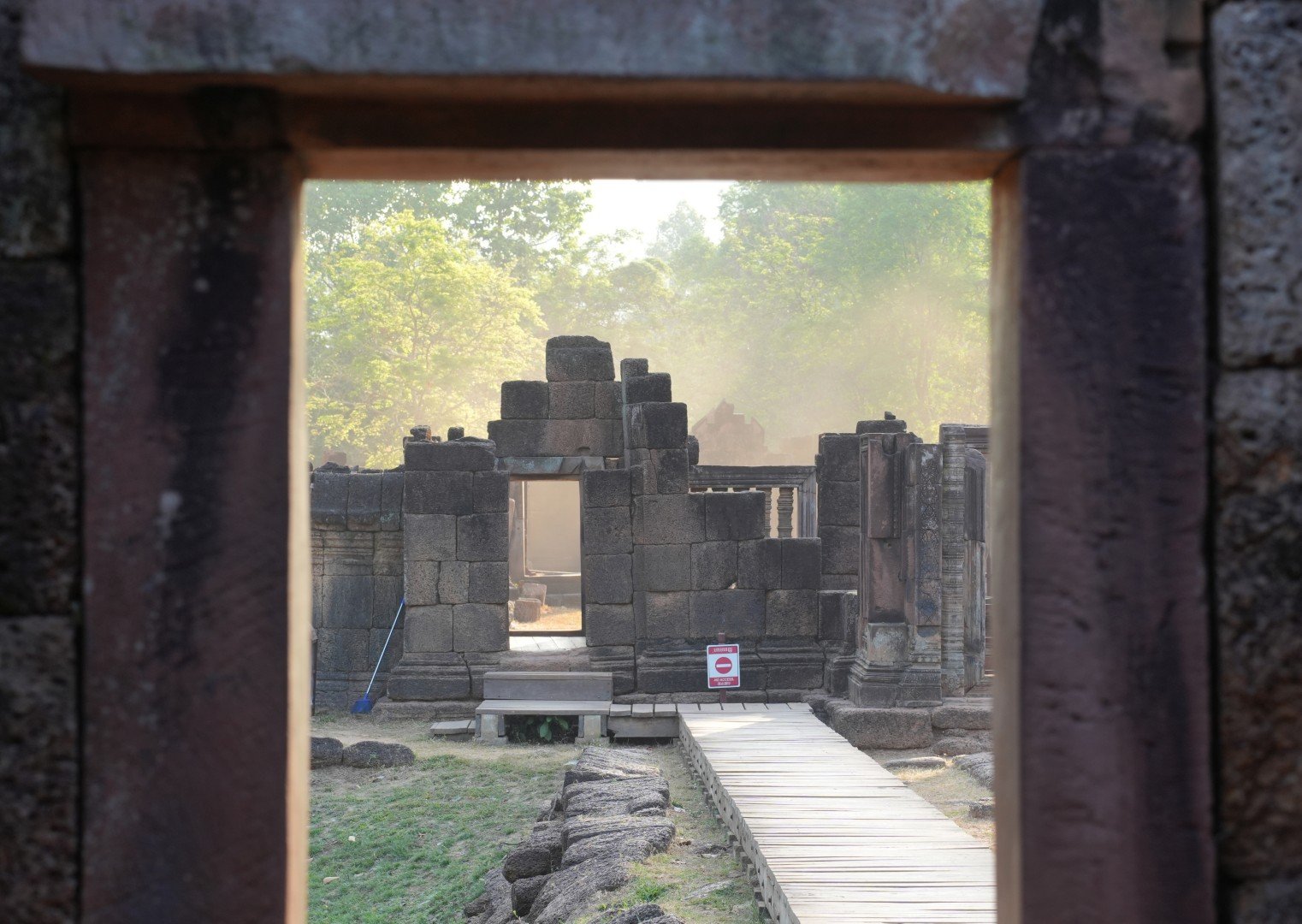
In the rich counties we have been inculcated with the aesthetic values of capitalism from advertising and in-your-face visual culture. Daniel Harris argues that these use images, ‘with the most vibrant hues; technicolour flora and fauna in arsenic greens, Titian reds, acid yellows, and shocking pinks [which] blinds us to the subtlety of the browns and greys of our everyday significance of everyday aesthetics’. The only ‘shocking’ colours here are the No Entry signs and the Parakeets. I have enjoyed the bare stone of Persepolis, Karnak and the Parthenon, not then knowing they were originally brightly coloured. Persepolis was painted in Egyptian blue, red and yellow ochre, green: Malachite and glauconite (green earth). The Parthenon also used Egyptian blue (and azurite), red ochre and red lead, white (gypsum) and greens/blacks. Statues were brightly painted with ornaments and garments. Karnak was originally a dazzling mix of brilliant blues, reds, yellows, greens, and white. This temple had no need of paint; the red sandstone is a wonder.
Thieves
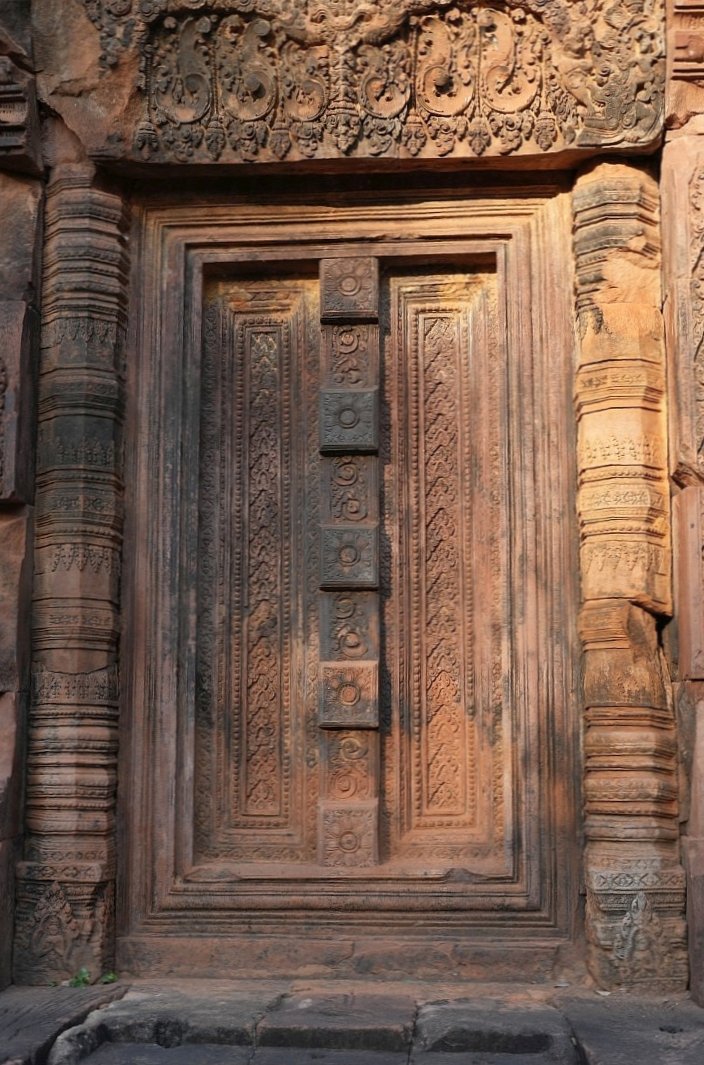 A library false door. The two outer buildings in the inner enclosure are ‘libraries’.
Banteay Srei is comprised of four enclosures encircled by a moat. Within the second enclosure are two ‘libraries’. The false doors in these two libraries are beautifully carved. The craftsmen must have expected wide-open wonder like a child seeing their first balloon.
I look at the carvings with a sense of wonder, surprise, and astonishment. I would like one.
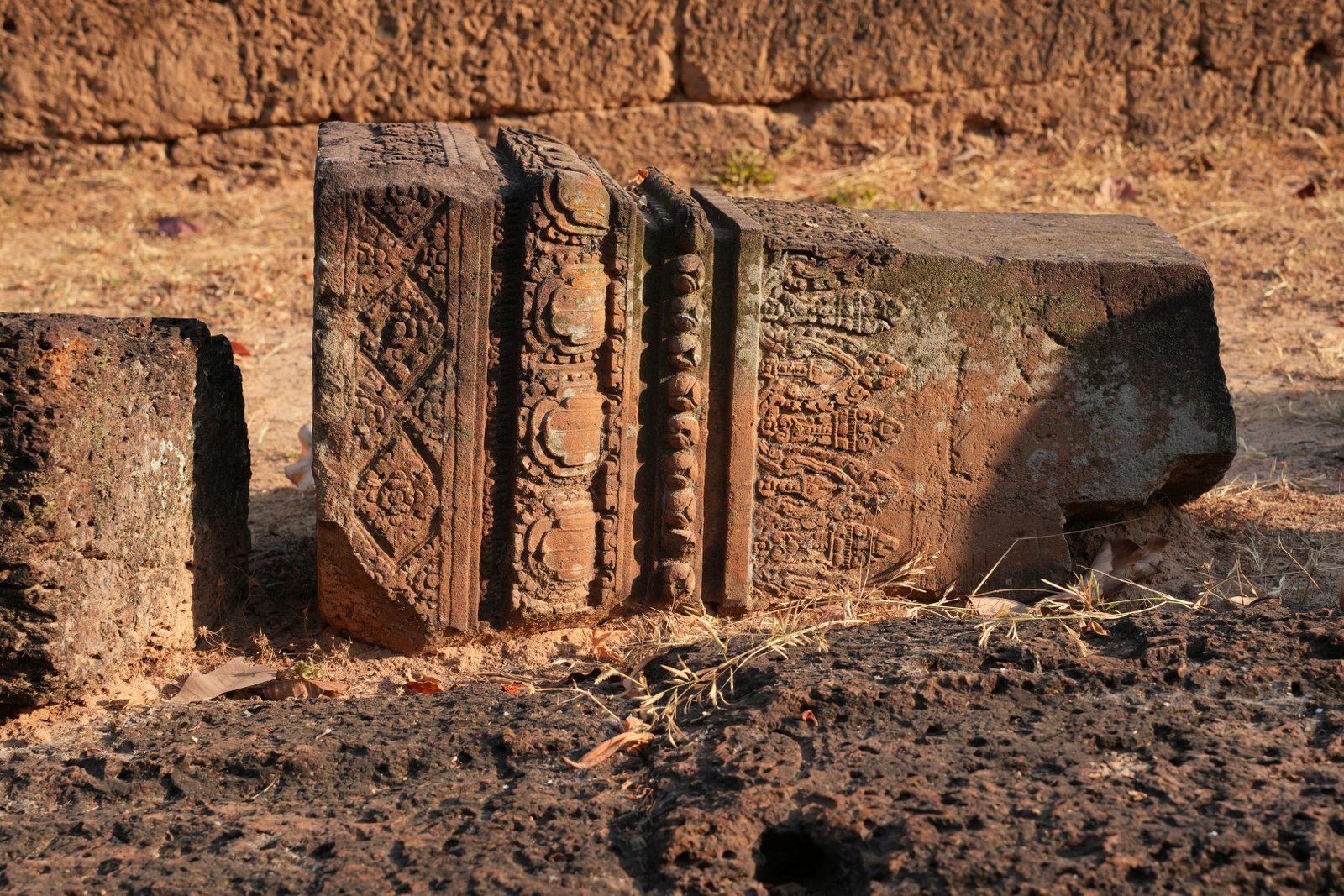
France ruled Cambodia for ninety years of profits. French firms exploited natural resource extraction, particularly timber, rubber, and rice. They acquired large tracts of land for plantations, displacing Khmer farmers. Then there was the robbery of Khmer cultural heritage, including statues and artifacts from temples, one example of how colonialism spread the global capitalist system. In 1953, King Sihanouk negotiated independence from France. Cambodia experienced economic growth and improved infrastructure, but also extensive political repression and corruption.
In the early 1920s, the Banteay Srei temple was still a mystery. André Malraux found a rare book at the Bibliotheque Orientale in Paris, by Lieutenant Marek, who had rediscovered the temple in 1914. Malraux headed there in 1923 with his first wife, Clara, on a mission to steal Khmer treasures to sell in Europe. Malraux was broke, he had lost money on the stock market. With his wife and friend Louis Chevasson, he removed four devatas and three other bas-reliefs from Banteay Srei. They damaged some of the pieces in the process.
They were arrested at Phnom Penh and Malraux was sentenced to three years in jail. He was a Frenchman in a French Colony and never went inside. A campaign for his release headlined by the surrealist Andre Breton led to his sentence being suspended.
He championed art that confronts the tragic nature of human existence: ‘Art is a revolt against fate.’

Malraux was an art theorist not art historian. He emphasised that art is a fundamental dimension of human experience, but also the importance of its historical and cultural context. Yet in The Museum without Walls (Le musée imaginaire de la sculpture mondiale, c. 1950) Malraux suggested that by decontextualizing art from local cultural and historical contexts, either through photographs or physical relocation to museums, one could abstract and discover universal forms and styles, and from there the essence of human creativity. An echo of Aby Warburg.
He wrote: ‘Our characteristic response to the mutilated statue, the bronze dug up from the earth, is revealing. It is not that we prefer time-worn bas-reliefs, or rusted statuettes as such, nor is it the vestiges of death that grip us in them, but those of life. Mutilation is the scar left by the struggle with Time, and a reminder of it — Time which is as much a part of ancient works of art as the material they are made of, and thrusts up through the fissures, from a dark underworld, where all is at once chaos and determinism.’
Malraux became part of the establishment. In 1958, Charles de Gaulle appointed him the Minister of Cultural Affairs: ‘Among his most memorable moments, the one that remains the most told has a delightful ambiguity. Malraux orchestrated the historic transfer of the Mona Lisa to the United States to please Jackie Kennedy – who asked for it during her visit to France. This gesture of diplomatic finesse and profound appreciation for art underscored Malraux’s dedication to fostering cultural exchanges – cementing his role as a luminary in cultural diplomacy and preservation.’
Wanting to own art, sell art, steal art (as a 22-yr old young man), he became a rich collector. In 2019, over 100 items from his private collection were auctioned, including artworks by Georges Braque and Joan Miró, art from Africa, New Guinea, Afghanistan and South East Asia. And a literary archive of books, manuscripts, and letters.
Derek Allan writes, ‘Malraux certainly didn’t regard art as completely explicable in terms of historical context . . . Malraux certainly believed – and said so clearly in Les Voix du Silence – that the placement of an object such as a Romanesque crucifix in an art museum fosters a change in its significance; but he never suggests that placing such objects in museums creates ‘their importance and validity’. The latter claim would place Malraux in the camp of ‘institutionalist’ art theorists (Danto, Dickie et al) with whom he has nothing in common.’
Museums take objects to ‘save them’. The Elgin Marbles are a point in case.
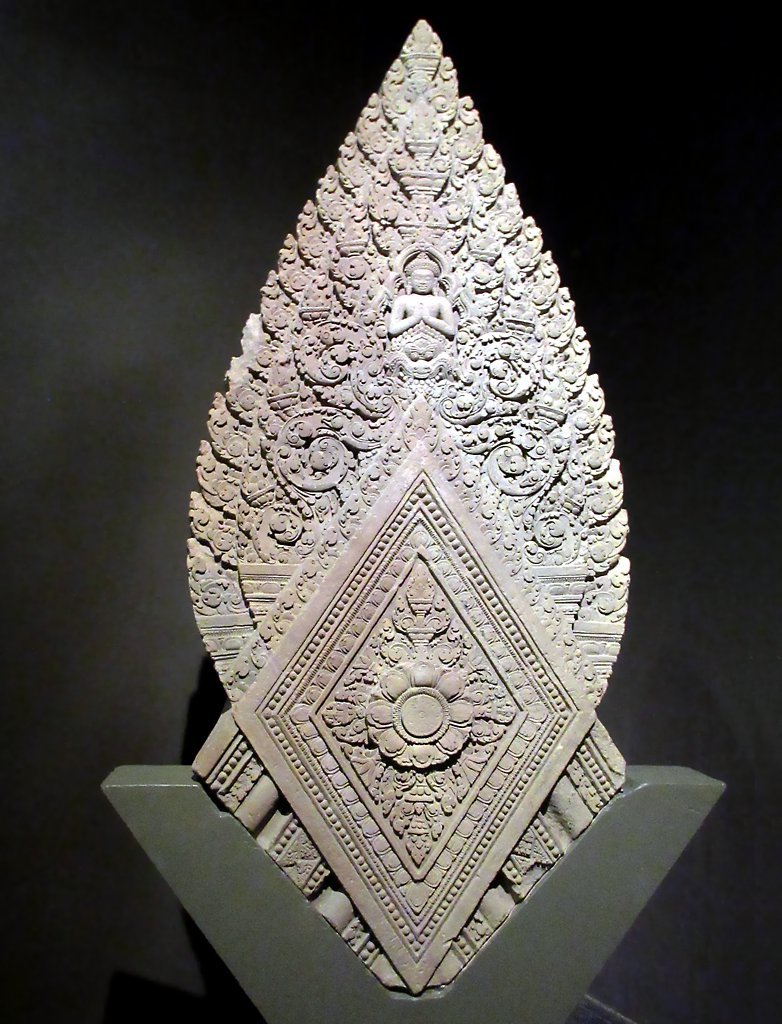
A Banteay Srei pediment in Angkor National Museum, Siem Reap. Features a lotus flower in a diamond-shaped chakachan pointing upward to a worshipper seated on a Kala head.
Siem Reap fell to advancing Vietnamese forces in January 1979 and Vietnam occupied Cambodia, for ten years. The fighting wasn’t over. Khmer Rouge operating from near the Thai border maintained a presence in northwestern Cambodia, including this area. Until the 1990s, researchers and visitors were denied access due to the danger.
‘The latest round of trouble began at the end of July 1993, when Khmer Rouge forces, many of whom are camped in the northernmost section of Angkor, crept out of their jungle strongholds in predawn darkness and overran Banteay Srei, a tenth-century temple to the gods Shiva and Vishnu. Banteay Srei, or Citadel of the Woman, is a gorgeous pink sandstone structure, with busty dancing figures, and is one of the most treasured of the seventy Angkor monuments, which are connected by a network of dirt roads and narrow pathways that wind through the jungle. In Siem Reap Province, officials of the United Nations Transitional Authority in Cambodia, or UNTAC, say that the guerrillas’ advance was met with little resistance from the Cambodian national Army, for its men were under orders not to open fire inside the monument grounds. Because the Khmer Rouge threatened to destroy Banteay Srei if it was not surrendered to them, the officials told me, the government troops had no choice but to retreat.’ Robert Bingham
In 1993, the International Council of Museums published a guide to 100 items known to have been looted from the Angkor temple complex. Due to looting in the 1970s and 1980s, most of the iconic, intact pediments and sculptures that remained were moved to the National Museum of Cambodia in Phnom Penh. During Cambodia’s civil wars and the communist Khmer Rouge’s brutal reign, criminal networks sent artifacts to Douglas Latchford. He was a prominent antiquities dealer who allegedly orchestrated a long-running scheme to sell looted Cambodian sculptures on the international market. He sold them on to Western collectors, dealers, and institutions. These pieces were often physically damaged, having been prised off temple walls or other structures by looters.
John D. Rockefeller 3rd was a scion of the establishment. He was an American financier and philanthropist, he gave extensive property he owned on West 54th Street in Manhattan for the site of the Museum of Modern Art, and purchased the George Grey Barnard collection of medieval art and cloister fragments for the Metropolitan Museum of Art, and purchased land for The Cloisters. In France he contributed to the restoration of the Palaces of Fontainebleau and Versailles, and rebuilding Reims cathedral. He purchased and donated land for many American National Parks, including Grand Teton, Mesa Verde, Acadia, Great Smoky Mountains, Yosemite and Shenandoah. He was also a thief.
‘In 1956, at the height of the Cold War, John D. Rockefeller 3rd established a new organisation known as Asia Society in New York. Rockefeller’s intention was to promote mutual understanding and engagement between America and Asia, and he saw art as fundamental to this mission. . . The Rockefeller’s collecting strategy was motivated not by region or medium, but by how exceptional the pieces were.’ . Assembled between the early 1950s and mid-1970s, the collection emphasizes masterpieces of high aesthetic quality, focusing on stone and bronze figures from the Angkor period. A particular strength was Khmer sculpture from Cambodia . . .The acquisition of these artifacts is recognized as part of a complex, mid-20th-century international market, with ongoing research into the provenance and history of the pieces.’ [Wiki]
‘The 8th-century Harihara, stolen in 1974 [during the Khmer Rouge rule] and smuggled across borders, didn’t just arrive at the museum. It was laundered into it—via a failed $1.8 million deal, a stopover at John D. Rockefeller III’s apartment, and a carefully engineered “donation” backed by one of America’s most powerful families. All roads lead back to Douglas Latchford, the indicted dealer at the heart of the global Cambodian looting network.
‘Met to return 16 Khmer relics linked to notorious artifact dealer. The New York museum says the latest repatriation of antiquities to Cambodia and Thailand effectively removes all Khmer works in its collection linked to alleged trafficker Douglas Latchford.’
Our notion of aesthetics is usually narrow, ignoring everyday aesthetics and non-western art. James Elkins criticises visual studies for its focus on ‘high art’ and contemporary images and its neglect of historic images, non-artistic and non-Western images.
The art world has been entangled in money for a very long time. Art markets emerged in Italy, Holland and Britain in the sixteenth century, though the first we know of was in Antwerp where The Church of Our Lady was renting booths out to painters and sculptors by 1480. Art auctions began in the 1660s in Restoration England. Terry Eagleton thinks the aesthetic is ideological and, ‘at the heart of the middle class’s struggle for political hegemony.’
Bojana Kunst laments the current situation, ‘the total appropriation of art by capitalism.’ Robert Hughes attacked prices on the international market as ‘degrading market hysteria’ and ‘a cultural obscenity’. The art critic Dave Hickey complains, ‘They’re in the hedge fund business, so they drop their windfall profits into art. It’s just not serious. Art editors and critics – people like me – have become a courtier class. All we do is wander around the palace and advise very rich people. It’s not worth my time.’ Orlando Whitfield describes, ‘the gooey layers of absurdity and frivolous late capitalism that the international art scene now embodies.’
With the patronage of kings and queens and popes and then industrialists faded, the most successful artists now operate factories: ‘Jeff Koons shows to a camera crew his massive, almost industrial workshop, where rows of assistants painstakingly create reproductions of old paintings for the artist’s Gazing Ball pieces. Koons is one of the most successful contemporary artists, and his works have broken the world record for highest auction price multiple times.’
Affluence finds a way, but the miracle of capitalism will implode one day – we will run out of nature.
We tourists are ephemeral consumers embedded in the system, with no way out. I don’t think it helps, but Sven Beckert wants us to look at capitalism, ‘with a sense of wonder, surprise, and astonishment—not because it is ‘good’ or ‘bad’ but because of its world-shaping power, and because understanding it is crucial to navigating our shared future.’
References
Manvir Singh, ‘The Hunt for the World’s Oldest Story: From thunder gods to serpent slayers, scholars are reconstructing myths that vanished millennia ago. How much further can we go—and what might we find?’, New Yorker, October 13, 2025.
Elizabeth M. Baeten, The Magic Mirror, Myth’s Abiding Power, SUNY, 1996, p20.
Elizabeth M. Baeten, p165.
Roland Barthes, Mythologies, trans. Annette Lavers, Hill and Wang, 1972, p151.
https://lucasvarro.com/blogs/my-journal/banteay-srei-temple
Daniel Harris, Cute, Quaint, Hungry and Romantic: The Aesthetics of Consumerism, Da Capo Press, 2000, p200.
In 1927, Aby Warburg began a project he never completed, the Bilderatlas Mnemosyne, now one of his most famous works. He traced recurring visual themes and and patterns across time, from antiquity to the Renaissance and beyond.
André Malraux, Part IV, Chapter VII, The Voices of Silence: Man and His Art, (1951) trans. Stuart Gilbert, Princeton UP, 1978.
‘The taste for beautiful things. André Malraux Collectiuon by Maison General Paris
https://www.maisongabrielparis.com/en/pages/collection-andre-malraux
Derek Allan, ‘Myths about Malraux’s Theory of Art’
http://home.netspeed.com.au/derek.allan/myths.htm#:~:text=Malraux%20certainly%20believed%20%2D%20and,in%20an%20art%20museum%20fosters
Robert Bingham, ‘Note from Cambodia, Political Ruins: Everyone is waiting to see what the Khmer Rouge will do when the U.N. withdraws from Cambodia. A clue may lie in their pillage of the temples of Angkor’, New Yorker, October 11, 1993.
In 2019, Latchford was indicted in a New York federal court on charges including wire fraud and conspiracy, though he died in 2020 at age 88 before he could be extradited to face charges.
Natali Pearson, ‘Museums, masterpieces and morals’, https://www.newmandala.org/museums-masterpieces-and-morals/, 24 Mar, 2017. ‘An exhibition of collection masterpieces at New York’s Asia Society Museum prompted Natali Pearson, PoP’s resident museum and heritage studies scholar, to reflect on provenance and ownership, and to ask whether museums are friends or foes in the quest to identify and repatriate stolen antiquities. What can, and should, we expect of these collecting institutions?
Tom Wright, ‘Explosive Rockefeller Letters Expose Met Museum’s Looted Harihara’, https://whalehunting.projectbrazen.com/ Jul 25, 2025.
Spencer Woodman December 15, 2023 https://www.icij.org/investigations/hidden-treasures/met-to-return-16-khmer-relics-linked-to-notorious-artifact-dealer/. In March, ICIJ reported that the museum’s catalogue contained at least 1,109 pieces previously owned by people who had been either indicted or convicted of antiquities crimes; 309 of them were then on display. The Met isn’t the only museum that has had to contend with Latchford’s legacy. Since ICIJ’s 2021 investigation, the Denver Art Museum, the National Gallery of Australia, and two major private collectors have returned Latchford-linked items to Southeast Asian countries. Smithsonian Institution Returns: The National Museum of Asian Art (NMAA) is returning a 10th-century “Head of Harihara,” 10th-century “Goddess Uma,” and a c. 1200 “Prajnaparamita”. These were removed during civil conflict (1967–1975) and linked to traffickers of looted Southeast Asian antiquities, per The Art Newspaper. Asian Art Museum of San Francisco is returning 13 masterpieces, including statues of deities and stone heads.
James Elkins, Visual Studies: A Skeptical Introduction, Routledge, 2003.
Terry Eagleton, The Ideology of the Aesthetic, Blackwell, 1990.
Bojana Kunst, Artist at Work: Proximity of Art and Capitalism, Zero Books, 2015.
‘Art Market a “Cultural Obscenity,” Says Robert Hughes’, Artforum, June 3, 2004.
Edward Helmore and Paul Gallagher, ‘Doyen of American critics turns his back on the ‘nasty, stupid’ world of modern art: Dave Hickey condemns world he says has become calcified by too much money, celebrity and self-reverence’, Guardian, 28 Oct 2012.
Orlando Whitfield, All That Glitters. A Story of Friendship, Fraud and Fine Art, Pantheon, 2024.
Dan Schindel, ‘A Documentary Lays Bare the Absurdity of the Art Market: The Price of Everything, which premiered at the Sundance Film Festival, looks at the trends and gambles of the art market.’ Hyperallergic, January 25, 2018. Director Nathaniel Kahn
Sven Beckert, Capitalism: A Global History, Penguin, 2025.